
As swing traders, we spend a lot of time focused on the S&P 500, the Nasdaq, and familiar U.S. economic data. But right now, one of the biggest clues about where the US stock market is headed comes from halfway around the world. Right now, one of the most important charts for any tech trader isn’t Nvidia or Apple (AAPL); it’s the iShares MSCI South Korea ETF (EWY).
Traders are often suffering from stock market crash paranoia, wondering when the house of cards will finally come crashing down. While many are watching the Middle East and the price of oil, the real canary in the coal mine for the global tech and AI boom might just be South Korea. Understanding this connection can give you a significant edge and help you manage risk before the volatility hits home.
Why South Korea Matters More Than Ever
At first glance, the South Korean stock market might seem disconnected from your U.S. tech portfolio. But when you look under the hood, you realize it’s the epicenter of the most important theme driving global markets today: semiconductors.
The Korean market is heavily dominated by two giants: Samsung Electronics and SK Hynix. These are not just any tech companies; they are two of the world’s largest and most critical producers of memory chips. These chips are the lifeblood of the AI revolution, essential for the high-performance GPUs, AI servers, and data centers that companies like NVIDIA (NVDA) are building.

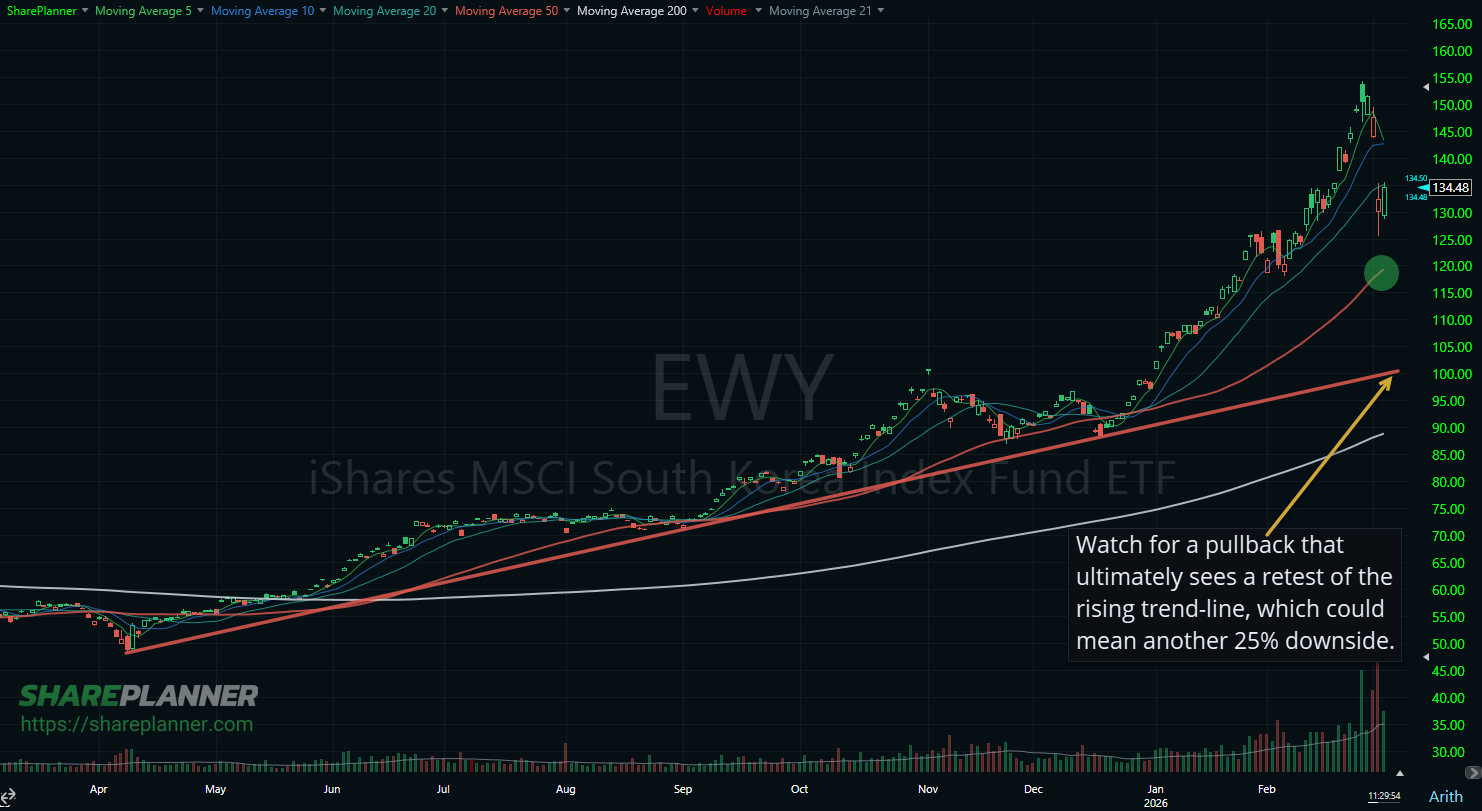
Because of this, the performance of Korean tech stocks is tightly linked to the same story driving the U.S. tech rally. In fact, Samsung and SK Hynix make up about half of the entire EWY ETF. When these Korean chip stocks sell off, it’s a powerful signal that sentiment around the entire global AI and semiconductor trade is weakening. That weakness almost always spills over into U.S. chip names like NVDA, Advanced Micro Devices (AMD), and Micron Technology (MU). Watching EWY gives you a preview of what might be coming for the Nasdaq.
The Macro Shock: Oil, War, and a Vulnerable Economy
The connection isn’t just about tech sentiment. The current geopolitical situation, particularly the conflict between the U.S. and Iran, is hitting South Korea harder than almost any other developed nation. The reason is simple: energy.
South Korea is extremely dependent on imported oil and natural gas. When energy prices spike due to war or supply chain disruptions, it acts as a massive tax on their economy. This macro stress puts immense pressure on their stock market, the Kospi, causing sharp declines that can even trigger circuit breakers.
This is where the two stories connect. A geopolitical shock in the Middle East drives up oil prices, which hurts the Korean economy, causing a sell-off in their stock market. Because their market is so heavily weighted toward semiconductors, this sell-off is concentrated in the very stocks that are tied to the global AI theme.
Investors around the world see this and start de-risking. They pull money out of crowded momentum trades, especially semiconductors, to protect themselves. The shock that started in Iran and rippled through Seoul finally lands on Wall Street, leading to an unwind in popular AI stocks.
How to Trade This Interconnected Market
Knowing this connection is one thing; profiting from it is another. We are human, so it isn’t going to be easy to always be perfect with our emotions as it pertains to the stock market, but here are some practical ways to use this information.
- Put EWY on Your Watchlist: Treat the EWY ETF as a leading indicator for the U.S. semiconductor sector (SMH). If you see EWY breaking down below a key support level or showing significant weakness, it’s a warning sign. This could be your signal to take profits on your U.S. tech winners or tighten your stop-losses.
- Watch the Red Trendline: As you can see from the chart of EWY, it has been riding a key rising trendline for much of its recent rally. A breakdown below this trendline would be a significant technical event. The chart suggests a retest of this trendline could lead to a further 25% downside. A move of that magnitude would almost certainly trigger a major correction in U.S. chip stocks.
- Use It as a “Risk-Off” Signal: When you see a combination of spiking oil prices and a falling EWY, that’s a classic “risk-off” signal. It means global macro funds are getting defensive. During these periods, it’s often best to reduce your overall market exposure, stay in cash, and wait for the volatility to subside.
- Trade the Divergence: Look for days when U.S. tech stocks are trying to rally but EWY is weak. This is a negative divergence. It suggests the rally in the U.S. lacks broad confirmation and is more likely to fail.
Traders often hold on to bad positions because they want to hope they will be right. I just care about being profitable, and that means being right about when I know I am wrong! If the South Korean market is screaming that a storm is coming for the semiconductor space, listen to it.
The market story is rarely as simple as what you see on financial news. While the headlines are focused on the direct conflict in the Middle East, the secondary effects on economies like South Korea can be a more powerful and predictive force for the sectors we trade every day. By adding EWY to your daily analysis, you can get ahead of the curve, protect your capital, and navigate the hidden cross-currents that truly move the market.
Become part of the Trading Block and get my trades, and learn how I manage them for consistent profits. With your subscription you will get my real-time trade setups via Discord and email, as well as become part of an incredibly helpful and knowledgeable community of traders to grow and learn with. If you’re not sure it is for you, don’t worry, because you get a Free 7-Day Trial. So Sign Up Today!
Frequently Asked Questions
Why does the South Korean stock market affect U.S. tech stocks?
South Korea is home to major semiconductor companies like Samsung Electronics and SK Hynix. Because these companies supply critical memory chips used in AI infrastructure, weakness in the Korean market often signals weakening demand or sentiment for the broader semiconductor sector.
What is the iShares MSCI South Korea ETF (EWY)?
EWY is an exchange-traded fund that tracks large South Korean companies. Because semiconductor giants dominate the index, it often acts as a leading indicator for the global chip industry.
Why do oil prices impact South Korea’s stock market?
South Korea relies heavily on imported energy. Rising oil prices increase economic pressure and can trigger sell-offs in the Korean market, which then spill over into global semiconductor stocks.
How can traders use EWY as a market signal?
Traders often watch EWY for early signs of weakness or strength in the semiconductor sector. A breakdown in EWY can signal risk for U.S. chip stocks like NVIDIA, AMD, and Micron.
What does a “risk-off” signal mean for traders?
A risk-off environment occurs when investors reduce exposure to volatile assets and move toward safety. In these periods, traders often reduce exposure, tighten stops, or hold more cash.


Welcome to Swing Trading the Stock Market Podcast!
I want you to become a better trader, and you know what? You absolutely can!
Commit these three rules to memory and to your trading:
#1: Manage the RISK ALWAYS!
#2: Keep the Losses Small
#3: Do #1 & #2 and the profits will take care of themselves.
That’s right, successful swing-trading is about managing the risk, and with Swing Trading the Stock Market podcast, I encourage you to email me (ryan@shareplanner.com) your questions, and there’s a good chance I’ll make a future podcast out of your stock market related question.
Watching the dollars rise and fall in your trading account can turn a well-planned swing trade into an emotional, deeply personal decision. In this episode, I explain why focusing on price action, percentage returns, and R-multiples can help you avoid cutting winners early, holding losers too long, and abandoning your trading plan.
Be sure to check out my Swing-Trading offering through SharePlanner that goes hand-in-hand with my podcast, offering all of the research, charts and technical analysis on the stock market and individual stocks, not to mention my personal watch-lists, reviews and regular updates on the most popular stocks, including the all-important big tech stocks. Check it out now at: https://www.shareplanner.com/premium-plans
📈 START SWING-TRADING WITH ME! 📈
Click here to subscribe: https://shareplanner.com/tradingblock
— — — — — — — — —
💻 STOCK MARKET TRAINING COURSES 💻
Click here for all of my training courses: https://www.shareplanner.com/trading-academy
– The A-Z of the Self-Made Trader –https://www.shareplanner.com/the-a-z-of-the-self-made-trader
– The Winning Watch-List — https://www.shareplanner.com/winning-watchlist
– Patterns to Profits — https://www.shareplanner.com/patterns-to-profits
– Get 1-on-1 Coaching — https://www.shareplanner.com/coaching
— — — — — — — — —
❤️ SUBSCRIBE TO MY YOUTUBE CHANNEL 📺
Click here to subscribe: https://www.youtube.com/shareplanner?sub_confirmation=1
🎧 LISTEN TO MY PODCAST 🎵
Click here to listen to my podcast: https://open.spotify.com/show/5Nn7MhTB9HJSyQ0C6bMKXI
— — — — — — — — —
💰 FREE RESOURCES 💰
— — — — — — — — —
🛠 TOOLS OF THE TRADE 🛠
Software I use (TC2000): https://bit.ly/2HBdnBm
— — — — — — — — —
📱 FOLLOW SHAREPLANNER ON SOCIAL MEDIA 📱
*Disclaimer: Ryan Mallory is not a financial adviser and this podcast is for entertainment purposes only. Consult your financial adviser before making any decisions.

You Might Like
South Korea: The Hidden Driver of US Tech Volatility

Stop Trying to Hit Home Runs: Start Trading Within Your Means
How to Trade Breakouts Without Getting Trapped