
There is a scenario that plays out every single day in the stock market. A stock you have been watching for weeks finally breaks out and starts running without you. It surges on heavy volume, blasts through resistance that held it back for months, and the green candles stack up fast.
Your heart starts racing. FOMO kicks in. You tell yourself that if you do not get in now, you will miss the entire move. So you buy the breakout at the high of the day. Then the stock stalls, rolls over, and drifts lower. Suddenly that breakout looks like a fake-out, and you are staring at a loss.
We have all been there. It is the classic bull trap. But here is the key difference between struggling traders and consistent ones. You do not have to chase breakouts. In fact, the real money is often made by being patient and trading the retest.
The Psychology of the False Breakout
To understand why retests work, you first need to understand why so many breakouts fail. When a stock clears a major resistance level, it attracts momentum traders, algorithms, and breakout chasers all at once. This creates a burst of buying pressure.
At the same time, traders who accumulated shares earlier use the spike as an opportunity to sell into strength. Others who were trapped at that level finally get back to break-even and sell to escape. Selling pressure hits just as breakout buyers run out of fuel.
The result is a pullback below the breakout level, trapping late buyers. This is why buying the initial breakout is often the most dangerous entry.

The Mechanics of the Retest
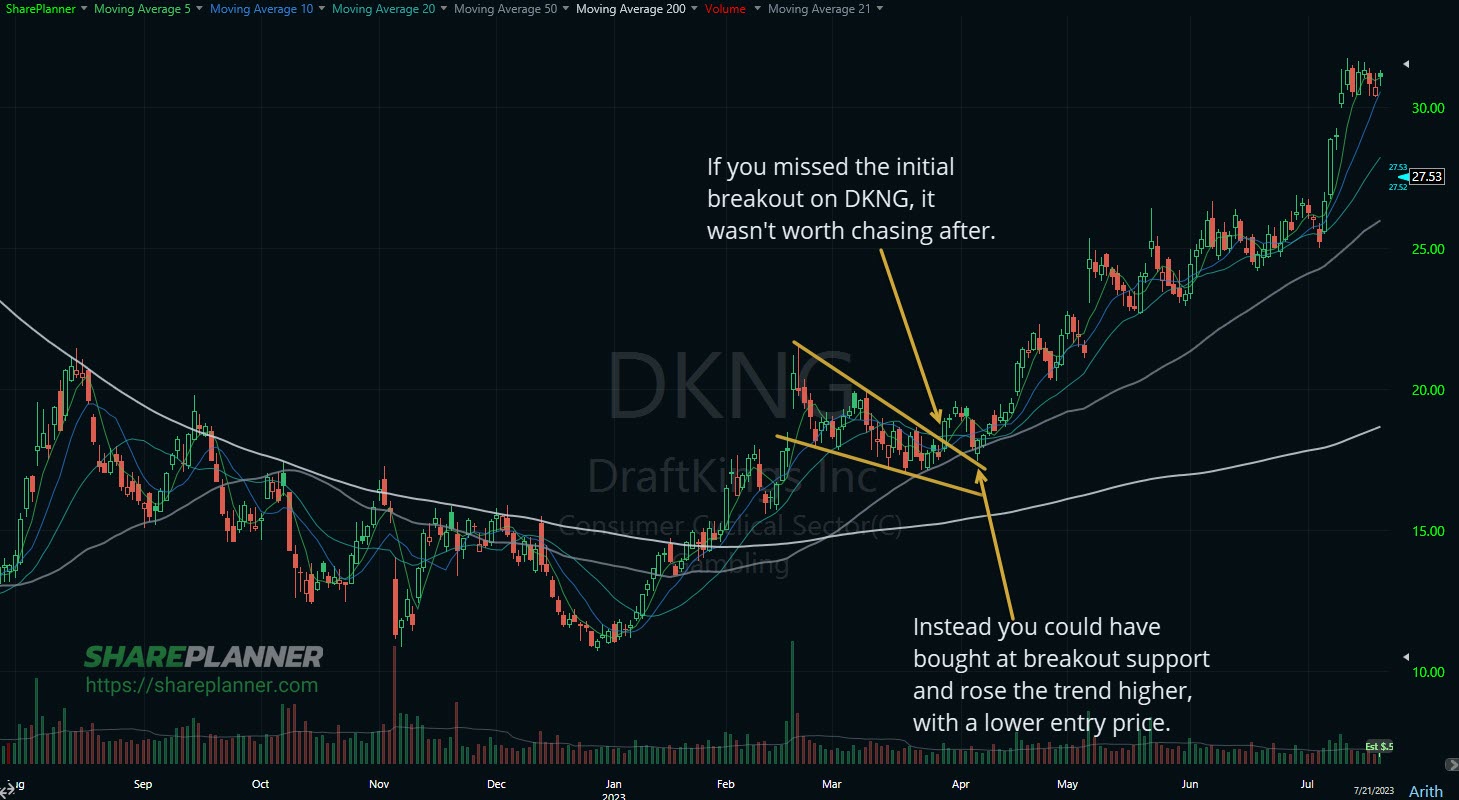
The retest strategy is built on patience. Instead of chasing the surge, you let the breakout happen and allow the excitement to cool off. Then you wait for price to pull back to the level it just broke.
This is based on a core technical principle called change of polarity. Broken resistance becomes new support. Broken support becomes new resistance.
When a stock breaks above a level like $100 and runs to $105, the psychology changes. When price pulls back toward $100, traders who missed the move see a second chance to buy, and traders who sold too early try to re-enter. That buying pressure often turns the old ceiling into a new floor.
Identifying a High-Quality Retest
Not every pullback is a retest. Some are failed breakouts that will continue lower. To filter out bad setups, I look for three specific signals.
1. Volume Contraction on the Pullback
A valid retest starts with strong volume on the breakout. That shows conviction. But when price pulls back, volume should contract.
- High-volume breakout: Buyers are serious.
- Low-volume pullback: Sellers are not aggressive.
If price collapses back to support on heavy volume, that is not a retest. It is rejection.
2. The “Touch and Go”
Price should gently test the breakout level or come close to it. It does not need to hit the exact penny, but it must respect the zone.
Look for long lower wicks, small-bodied candles, or dojis. These signal that buyers are stepping in each time price dips into support.
3. The Curl
This is the entry trigger. You do not buy simply because price touched support. You wait for price to curl back higher.
That may be a green daily close or a break above the prior day’s high. This confirms that buyers have regained control.
Risk Management: Why the Retest Works
The biggest advantage of trading retests is risk control.
If you chase a breakout at $105 from a $100 level, your stop often has to go below $99. That creates wide risk. But if you buy the retest near $101, you can place a stop just below support.
Waiting for the retest allows you to:
- Improve your entry price.
- Tighten your stop-loss.
- Increase your reward-to-risk ratio.
If the retest fails and price closes back below support on volume, the trade thesis is broken. You exit with a small loss and move on.
Why Patience Pays
Trading retests requires discipline. It means watching stocks run without you and resisting the urge to chase. Some breakouts will never retest, and you will miss them.
That is okay. We are not trying to catch every move. We are trying to capture the highest-probability moves with the lowest risk.
The retest filters out false breakouts and proves that demand is real. It confirms that the new price level is accepted by the market.
The next time a stock explodes higher, put your hands in your pockets. Set an alert at the breakout level. If price comes back on light volume and holds, that is your opportunity.
Become part of the Trading Block and get my trades, and learn how I manage them for consistent profits. With your subscription you will get my real-time trade setups via Discord and email, as well as become part of an incredibly helpful and knowledgeable community of traders to grow and learn with. If you’re not sure it is for you, don’t worry, because you get a Free 7-Day Trial. So Sign Up Today!
Frequently Asked Questions About Trading the Retest
What is a retest in trading?
A retest occurs when price pulls back to a former resistance level after a breakout and holds that level as new support.
Why do breakouts often fail?
Breakouts fail when early buyers sell into strength and trapped traders exit at break-even, creating selling pressure.
Is it better to buy the breakout or the retest?
Buying the retest usually provides a better entry with tighter risk and higher reward-to-risk than chasing the initial breakout.
How do you know if a retest is valid?
Valid retests show declining volume on the pullback, price respecting support, and a bullish reversal signal.
What invalidates a retest setup?
A close back below the breakout level on heavy volume invalidates the setup and signals a failed breakout.
Do all breakouts retest?
No. Some stocks continue higher without retesting. Missing those moves is part of disciplined trading.


Welcome to Swing Trading the Stock Market Podcast!
I want you to become a better trader, and you know what? You absolutely can!
Commit these three rules to memory and to your trading:
#1: Manage the RISK ALWAYS!
#2: Keep the Losses Small
#3: Do #1 & #2 and the profits will take care of themselves.
That’s right, successful swing-trading is about managing the risk, and with Swing Trading the Stock Market podcast, I encourage you to email me (ryan@shareplanner.com) your questions, and there’s a good chance I’ll make a future podcast out of your stock market related question.
How does war impact the stock market and what are the potential risks and hazards that impact traders attempting to remain profitable in their swing trading? In this podcast episode, Ryan Mallory covers everything managing the volatility that comes with the headline risk, dealing with heightened levels of emotions, securing open profits, and market exposure to uncertainty in the stock market.
Be sure to check out my Swing-Trading offering through SharePlanner that goes hand-in-hand with my podcast, offering all of the research, charts and technical analysis on the stock market and individual stocks, not to mention my personal watch-lists, reviews and regular updates on the most popular stocks, including the all-important big tech stocks. Check it out now at: https://www.shareplanner.com/premium-plans
📈 START SWING-TRADING WITH ME! 📈
Click here to subscribe: https://shareplanner.com/tradingblock
— — — — — — — — —
💻 STOCK MARKET TRAINING COURSES 💻
Click here for all of my training courses: https://www.shareplanner.com/trading-academy
– The A-Z of the Self-Made Trader –https://www.shareplanner.com/the-a-z-of-the-self-made-trader
– The Winning Watch-List — https://www.shareplanner.com/winning-watchlist
– Patterns to Profits — https://www.shareplanner.com/patterns-to-profits
– Get 1-on-1 Coaching — https://www.shareplanner.com/coaching
— — — — — — — — —
❤️ SUBSCRIBE TO MY YOUTUBE CHANNEL 📺
Click here to subscribe: https://www.youtube.com/shareplanner?sub_confirmation=1
🎧 LISTEN TO MY PODCAST 🎵
Click here to listen to my podcast: https://open.spotify.com/show/5Nn7MhTB9HJSyQ0C6bMKXI
— — — — — — — — —
💰 FREE RESOURCES 💰
— — — — — — — — —
🛠 TOOLS OF THE TRADE 🛠
Software I use (TC2000): https://bit.ly/2HBdnBm
— — — — — — — — —
📱 FOLLOW SHAREPLANNER ON SOCIAL MEDIA 📱
*Disclaimer: Ryan Mallory is not a financial adviser and this podcast is for entertainment purposes only. Consult your financial adviser before making any decisions.

You Might Like
Stop Trying to Hit Home Runs: Start Trading Within Your Means
How to Trade Breakouts Without Getting Trapped

Managing Headline Risk: How to Survive the News Cycle Without Losing Your Mind