

Episode Overview
In today’s episode, I go over the major reasons why traders fail and the biggest obstacles to finding success as swing traders in the stock market.
Available on: Apple Podcasts | Spotify | Amazon | YouTube
Episode Highlights & Timestamps
- [0:00] Opening Thoughts on Trader Failure
Ryan introduces the episode by asking the big question: Why do most traders fail? He shares how this topic originated from a returning listener known as “Bocephus.” - [1:09] Listener Breakdown: 3 Common Pitfalls
Bocephus shares his top reasons for failure: lack of planning, chasing hype stocks, and being greedy. Ryan agrees and dives into each point. - [2:08] Risk Management and Market Laziness
Ryan discusses how current market conditions reward reckless trading, making it difficult for disciplined traders to follow their plans without frustration. - [4:00] The Serial Killer Analogy
Drawing an unusual comparison, Ryan likens undisciplined traders to serial killers, explaining how repeated risky behavior eventually ends in catastrophe. - [13:21] Instant Gratification and Market Scams
Ryan concludes with a warning against get-rich-quick trading and online scams. He shares a personal story illustrating how dangerous overleveraging and impatience can be for new traders.
Key Takeaways from This Episode:
- Discipline Over Recklessness: Just because the market is rewarding risky behavior today doesn’t mean it will tomorrow. Stick to disciplined trading practices.
- Use Technical Analysis, Not Hype: Chasing top gainers without technical justification almost always ends in failure.
- Partial Profits Preserve Capital: Taking gains along the way reduces emotional strain and protects against reversals.
- Manage Risk Like a Pro: Risk management is only useful if you follow through. Don’t deviate from your trading plan.
- Avoid Instant Gratification: Long-term trading success requires patience, hard work, and avoiding the illusion of overnight riches.
Resources & Links Mentioned:
- Swing Trading the Stock Market – Daily market analysis, trade setups, and insights by Ryan Mallory.
- Join the SharePlanner Trading Block – Get real-time trade alerts and community support.

Take the Next Step:
✅ Stay Connected: Subscribe to Ryan’s newsletter to get free access to Ryan’s Swing Trading Resource Library, along with receiving actionable swing trading strategies and risk management tips delivered straight to your inbox.
? Level Up Your Trading: Ready for structured training? Enroll in Ryan’s Swing Trading Mastery Course, The Self-Made Trader, and get the complete trading course, from the foundational elements of trading to advanced setups and profitable strategies.
? Join the Trading Community: Sign up for SharePlanner’s Trading Block to become part of Ryan’s swing-trading community, which includes all of Ryan’s real-time swing trades and live market analysis.
Full Episode Transcript
Click here to read the full transcript
0:00
Hey everybody. This is Ryan Mallory with shareplanner.com’s. Swing Trading the Stock Market. In today’s episode, we’re going to talk about why do traders fail? What is it about trading that so many people cannot find success in the stock market? Why is it that it is that success is so elusive for so many traders?
0:18
That’s what we’re going to talk about today. In the today’s e-mail comes from a guy who’s been the show numerous times before. If you’ve listened to a lot of the episodes in the past, you might recognize this name. And for those who don’t know or who are new to the show, I give people good Florida redneck names. Why? Because I’m from Florida.
0:34
I was raised redneck. So yeah, we give everybody Florida redneck names around here. And in this case, Bocephus is a has multiple episodes dedicated to him because he always asks really good questions. And so Bocephus writes. Hey Ryan, I have written the show before.
0:51
As I’ve already mentioned, I have gone by the name of Bocephus and I’ve been doing some live trading and some paper trading to test some of my strategies. In my first month, I saw some wins and some losses. Overall, I’m up about 2% of my live account and 10% in my paper trading account.
1:09
This may be a simple question, but I feel like there are multiple answers or a multitude of answers. And what is it that you think that or the reason why most traders fail? I was thinking of my own failures and came up with just a few, but I wanted to see what you may add to or what you may want to elaborate more on #1 the lack of planning.
1:31
Planning trades, not managing risk #2 chasing pump and dump stocks instead of using technical analysis. Guilty as charged on this one, he says. Well, in fact, I would say we’re all guilty of that #3 being greedy and not taking small profits. Profits, when the opportunity presents itself, that is.
1:47
Thank you for all of your great content. God bless Bocephus. OK, there’s a lot to unpack here because I don’t think he’s wrong at all on on three of the reasons that he gives. And I think there’s a couple more that we can dig into as well. But the lack of planning trades and not managing risk, and I would probably add to that the lack of follow through on those plans.
2:08
A lot of people will say, yeah, I want to manage the risk. I think it’s so important, but then when it actually comes to following through, they find themselves breaking their rules. And that’s one of the things you can’t afford to do as traders. There’s going to be many times where you can break the rules and the market will forgive you of it. We’re in that right now and there’s we’re in a market that affords you to be lazy with planning your trades out and to not have to follow your trading plan and you get rewarded for it.
2:36
And that can be kind of a, a frustrating thing for those who manage the risk because when you manage the risk and then you get stopped out and you watch it just bounce right back up. So often times before the market even closes, that can get a little bit on the frustrating side of things. So the lack of planning trades and not managing the risk is a real thing right now in the stock market.
2:56
We’re seeing that in real time with the greed and laziness that’s being played out across the market. You got 10 stocks that make up 38% of the stock market. Most of the time people were just buying those at this point, buying NVIDIA, hoping to sell it the next day for a 3% gain, which by and large is is been working quite a bit since the April bottom lows.
3:18
And the market’s been rewarding that behavior. So as a conservative trader, if you’re a person that’s going to be dogmatic about managing the risk and following your stop losses, there’s going to be some frustrations because you’re going to get stopped out and you’re going to watch it go right back up. I had that happened with me with Broadcom got stopped out of it last week.
3:34
I and I actually had a really good gain and closed out with a really good gain. It was like over 10%. But where the frustrating part came in as soon as I got stopped out, next three or four days it goes straight back up. And that’s that’s one of the frustrating parts of being a conservative trader and being a disciplined trader is because right now we’re in a market that’s rewarding essentially aggressive and a reckless behaviors.
4:00
You’re seeing that with a 0 DTE trading and for those who don’t know what that is, it’s where you’re essentially buying stock options with 0 days to expiration. It basically you better get into the money assuming that you’re buying out of the money stocks and that’s what most of them are doing. But you got to get into the money before the close of the day.
4:18
That was almost unheard of 5-10 years ago. Nobody did that. Now it’s it’s a household trading strategy that so many people are trading in. I’ve met used car salesman, I’ve met Realtors, I’ve met people from all different walks of life, doctors, lawyers, they’re all doing it.
4:36
And it’s been by and large working, just buying the dip. And it’s such a collective mentality. Everybody’s doing it. But one of the things that tends to happen is when you’re not managing risk along the way and you’re getting away with it, you’re going to continue to do that until when?
4:52
Until you get caught and and it blows up in your face. I used it probably like 2 or 300 episodes ago and it really resonated with a lot of people. I talked about the serial killer and how so many people trade like a serial killer. And what do I mean by that? Is that what do serial killers do?
5:08
They continue to kill people until they get caught. And so that’s why so you hardly have any of them that just all of a sudden disappeared into thin air. They keep going forward with their victims and eventually they get caught, they slip up, they mess up and what is it?
5:24
What is it result in life in prison, electric chair, lethal injection, one of those. But that’s what happens. And, and, and trading is very similar behaviors across a lot of traders. They keep going until they the account blows up in their face.
5:41
And that’s what you really want to avoid in your training. You don’t want the account to blow up in your face because you were greedy and lazy most of the time, especially of late. Swing trading is not going to blow up in your face if you, if you decide not to use a stop loss here or there.
6:00
But what it is, it’s the practice, the habitual practice of ignoring those stop losses and, and eventually it gets you. And then you find yourself against the 2022 market or a 2018 market, or perhaps it may be even far worse than you’re dealing with a 2008 market and you completely blow up the account.
6:18
That’s what you’re trying to avoid chasing pump and dump stocks instead of using technical analysis. Why do we use technical analysis? This is the second point that he was making. Bocephus, why do we use technical analysis to be able to plan out our trades? Because, and I talked about this in the last episode as well, with technical analysis, you’re able to see where the institutions, where the hedge funds where, where the big money is flowing into.
6:42
You can see where the key support levels are and where people are consistently buying at. And so it makes sense to put your stop losses below those levels because if it doesn’t hold up this time, then you want to be out of the trade. But a lot of people don’t do that. They look at what are the top gainers on the day. O stock ABC is up 40%. Great. I’m going to go buy that one and try to ride it up another 40%. Maybe they get lucky on that, but they’re probably going into that with very little risk management because those trades by and large are almost impossible to manage.
7:16
So chasing the pump and dump stocks, we’ve all done that. Just like we we talked about earlier, we’re all guilty of this. I started off, I was going after pump and dumps as well. It took losing on those pump and dumps to realize I needed to start managing the risk #3 being greedy and not taking profits along the way when opportunity presents itself.
7:32
And one of the most frustrating things, you buy the stock at, you know, let’s say stock ABC at 100 and it goes up to 105 and then all of a sudden it comes back down to 101. What do you find yourself doing? You’re like, I got to get out of this. I was just up 5% and now it’s I’m only up 1%.
7:48
I can’t, I can’t stay in this trade. I got to get out of it. And So what, what traders will do, they’ll get out and then as soon as they get out, there wasn’t really a technical reason for getting out. What they do is they get out and then all of a sudden the stock goes right back up and then they’re even more mad. They get they get back in at let’s say one O 5 and then the stock goes down to 98 or whatever.
8:07
That kind of stuff can be very frustrating and it can be very upsetting. But what you want to avoid is not taking partial profits along the way. But one of the things I would tell you is this taking profits along the way has served me immensely well.
8:24
And it wasn’t always like that. There was, there’s so many times where I didn’t want to take profits and I struggled with that because I wanted to hold out for a bigger gains. And it took me a while to understand that. And and it goes alongside with my, my training course, the self-made trader. And you can go to shareplanner.com, click under Academy and it’ll take you to the self-made trader.
8:46
This is my life’s work. This is my flagship course. This is what I’ve spent the past four years putting together a training course that would really teach you everything that I’ve learned over 30 years of trading, everything from the very beginnings of trading to the more advanced strategies. And with that you’ll get 25 hours of instructional video.
9:03
For me, it’s, it’s a ton and it’s a lot of work. And I’m not going to sell it short and tell you that it’s not going to take a lot of work. It is it’s not something that you’re going to to watch 30 minutes of of training and all of a sudden you’re can be an expert trader by far from that. It’s a 14 week course.
9:19
It’s a really good course. I would encourage you to check it out, the self-made trader at shareplanner.com. Just click on the Academy tab on on the upper part of the page and you’ll be able to check it out for yourself and see exactly what kind of value it brings for you. But the partial profits, it’s such an essential part of my trading and it really frees me up to be able to pursue bigger gains in my trades ultimately with a smaller position.
9:45
But that’s OK because if I was trading a full position, I would never let it really stretch its legs and go the full distance. When I get down to that ride or die, it really frees me up to really see how long or how far I can take it. I’ve been training Caterpillar and I, I got in like 365, it’s over 400 now.
10:03
There’s a good chance that I never would have let it run that far if it was a full position. But because I’ve I’ve been able to take some profits along the way, it sets me up to be able to let it continue to run higher. But with partial profits that first pull back, you’re going to be inclined to go ahead and take, take take the the smaller profits and just get out of the trade in total.
10:25
You want to avoid that partial profits are essential because you’re reducing the risk and especially if you couple that with a stop loss increase, man, you’re really curbing the risk factors that that could be working against you and and doing a better job of ensuring that you’ll walk away with at least a small profit.
10:42
So many times in my trading, I have seen my stocks, my, the stock that I trade, I’ll take that first profit and then all of a sudden it runs against me and I’m out of the trade because it hit my stop loss. Now, if I was in a full position, I would have taken a loss on that trade, but because I was taking partial profits along the way, I took either half or a third of my trade off the table.
11:03
I’m actually doing pretty good as a result. So the partial profits are huge. So what what is causing people ultimately to to fail as traders? That’s that’s really the question that we’re asking in this podcast right now. We’re in the biggest asset bubble we’ve ever seen.
11:20
We have a a market PE of 27 versus the.com bubble PE high of 25. So we’re well beyond that market bubble that we saw in the late 90s and early 2000s. You have, I’ve mentioned this earlier, 10 stocks representing 38% of the S&P 500, just massive amounts.
11:39
You just saw Microsoft report earnings after hours and jump from a 300 and or $3.8 trillion company to over $4 trillion. And these companies are just ripping off gains like it’s no big deal. Back in the day, your Walmarts and GES and that they didn’t move like that.
11:57
They just didn’t they were very slow movers. The bigger the company, the slower they were. Now you have NVIDIA, biggest company in the world and they will RIP off 4 or 5% in a single day. Like it’s not a big deal. And I get the AI is a is a huge disruptor, but we’re getting into some like real fugazi type of numbers with some of the stocks that we’re seeing trading.
12:17
And, and you take NVIDIA, which really didn’t even have any major news that came out about it ads on a just a casual $300 billion to its market cap in one single day, July 9th. It was, it just crossed the, the $4 trillion threshold.
12:33
Now it’s well on its way to 5 trillion. And it may even see that before the end of August. I wouldn’t even, I actually would be more surprised if we didn’t see it hit 5 trillion by the end of August the way it’s going right now.
12:51
But what’s going to be the difference is that these aggressive traders will not last long term because their aggressive behaviors is what’s going to set them up for significant losses. When you do eventually see either the bubble pop or you just get a, a minor pullback of some sorts. Maybe it’s like the one that we saw back in April of this year where we pulled back, you know, about 20% that wiped out a lot of traders, but because it was so fast, it didn’t really destroy too many because they were able to ride it right back up to the all time highs.
13:21
I’ll end with this story and this is one of the big things too, and I’m going to, this is an additional reason why so many traders don’t make it and it’s instant gratification. We talked a little bit about 0 DT ES earlier. There was also a time where NF TS were huge spax.
13:39
I mean, there’s always like these themes of that that people are chasing and they they chase it to delusional levels and then they get just completely annihilated when reality sets in. I have a friend, actually one of the a friend of one of my kids and I, I was, I was at a a get together at my house.
13:59
I like to cook pizzas a lot on Friday nights. So, so he was there and he was telling me about how he likes to trade futures. I’m like, OK, tell me about this stuff. I, you know, I’m always interested in hear what people are doing, especially when they tell me they’re trading futures because it’s such a leveraged product. And he’s like, yeah, I, I struggled a lot.
14:16
I lost like 4 or $500 initially, but then I’m on the way back. I doubled down at this particular level and I doubled down again. I’m like, Oh my gosh, how many contracts does this kid have? I mean, he’s just fresh out of college and he’s, I tried to give him a, some understanding that, hey, you got to manage the risk.
14:33
You’ve got to figure out where you’re going to get out because now he’s getting just getting buried in these futures contracts. He’s like, no, no, no, no, no, I, I’ve got it figured out now. I, I asked ChatGPT some questions. I was able to get some clarity. I’m like, Oh my goodness. So why is he doing that?
14:49
He’s trading his super leverage assets and he’s looking for that instant gratification. They’re not willing. So many of people are not willing to go through the hard work that is necessary to get to where you need to be to realize and find success in the stock market.
15:05
And it doesn’t come overnight, doesn’t come through the pump and dumps. It doesn’t come through the Facebook ads that you see all over the place with these people guaranteeing $10,000 a day. I’ve actually seen somebody that puts on Facebook that they will pay for your losses. Guys, that guy is not paying for your losses.
15:22
They’re scamming you and there’s so many of that out there and there’s so many people because they’re desperate for that instant gratification that they fall for it. And I’m begging you not to fall for it. Know that trading is going to be hard if you’re going to get into it, it is, it’s guaranteed. It’s just not rewarding people like what you see on social media and on the ads and, and so many people, they go into it.
15:43
They start trading the zero DT ES. They want the leverage and they just blow up their accounts in the process. So I would implore you to take a steady approach to it, avoid the greediness, the laziness, take some partial profits along the way.
16:00
And I think that you’ll find some, some incredible results if you stay diligent in that process. If you enjoyed this podcast episode, and I hope you did, please make sure to to leave me a five star review on whatever platform you’re listening to me on. If it’s on YouTube, then make sure to like and subscribe and leave me some comments about what do you think causes most traders to fail.
16:21
What has been the biggest struggle for you as a trader defining success in the stock market? I want to hear about it. Also send me your questions ryan@shareplanner.com. I want to hear about your struggles. I want to see what you’re you’re dealing with. I’m not going to use your real name. The only person I’ll read the e-mail is me and make sure to check out the self-made Trader at shareplanner.com.
16:40
Click on the Academy tab and it’ll take you right to it. Thank you guys, God bless. Thanks for listening to my podcast, Swing Trading the Stock Market. I’d like to encourage you to join me in the SharePlanner Trading Block where I navigate the stock market each day with traders from around the world.
16:56
With your membership, you will get a seven day trial and access to my trading room including alerts via text, e-mail and WhatsApp. So go ahead, sign up by going to shareplanner.com/trading Block. That’s www.shareplanner.com/trading-block and follow me on SharePlanner’s Twitter, Instagram and Facebook where I provide unique market and trading information every day.
17:17
If you have any questions, please feel free to e-mail me at ryan@shareplanner.com. All the best to you and I look forward to trading with you soon.
Enjoy this episode? Please leave a 5-star review and share your feedback! It helps others find the podcast and enables Ryan to produce more content that benefits the trading community.
Have a question or story to share? Email Ryan and your experience could be featured in an upcoming episode!
Become part of the Trading Block and get my trades, and learn how I manage them for consistent profits. With your subscription you will get my real-time trade setups via Discord and email, as well as become part of an incredibly helpful and knowledgeable community of traders to grow and learn with. If you’re not sure it is for you, don’t worry, because you get a Free 7-Day Trial. So Sign Up Today!

Welcome to Swing Trading the Stock Market Podcast!
I want you to become a better trader, and you know what? You absolutely can!
Commit these three rules to memory and to your trading:
#1: Manage the RISK ALWAYS!
#2: Keep the Losses Small
#3: Do #1 & #2 and the profits will take care of themselves.
That’s right, successful swing-trading is about managing the risk, and with Swing Trading the Stock Market podcast, I encourage you to email me (ryan@shareplanner.com) your questions, and there’s a good chance I’ll make a future podcast out of your stock market related question.
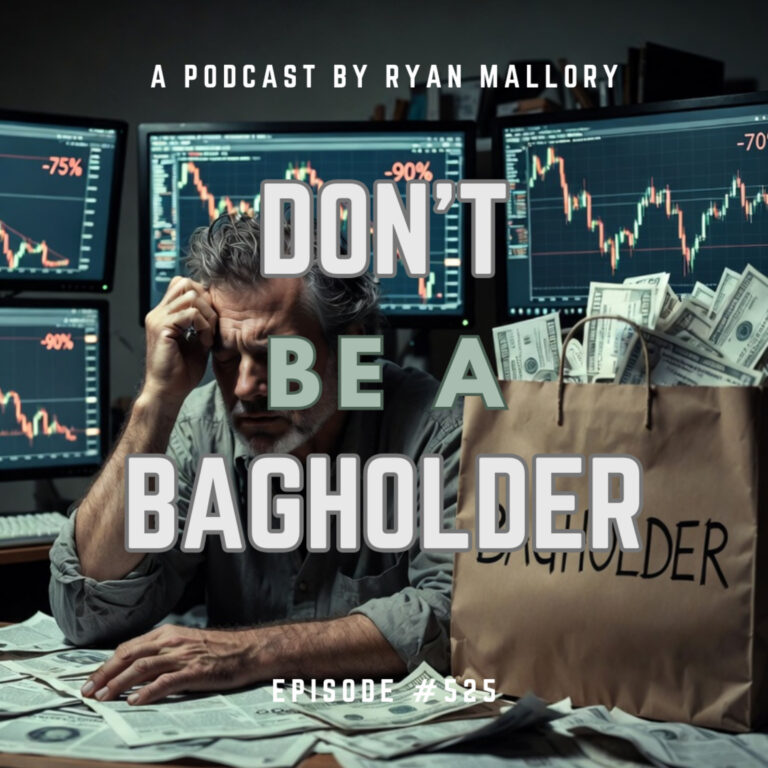
Refusing to take a loss when the trade has turned, and the reason for getting into the trade in the first place is no longer valid, is one of the biggest problems traders face. In this video, Ryan Mallory discusses the pitfalls that comes with refusing to take the loss and instead opting to become a bagholder on one's trades.
Be sure to check out my Swing-Trading offering through SharePlanner that goes hand-in-hand with my podcast, offering all of the research, charts and technical analysis on the stock market and individual stocks, not to mention my personal watch-lists, reviews and regular updates on the most popular stocks, including the all-important big tech stocks. Check it out now at: https://www.shareplanner.com/premium-plans
📈 START SWING-TRADING WITH ME! 📈
Click here to subscribe: https://shareplanner.com/tradingblock
— — — — — — — — —
💻 STOCK MARKET TRAINING COURSES 💻
Click here for all of my training courses: https://www.shareplanner.com/trading-academy
– The A-Z of the Self-Made Trader –https://www.shareplanner.com/the-a-z-of-the-self-made-trader
– The Winning Watch-List — https://www.shareplanner.com/winning-watchlist
– Patterns to Profits — https://www.shareplanner.com/patterns-to-profits
– Get 1-on-1 Coaching — https://www.shareplanner.com/coaching
— — — — — — — — —
❤️ SUBSCRIBE TO MY YOUTUBE CHANNEL 📺
Click here to subscribe: https://www.youtube.com/shareplanner?sub_confirmation=1
🎧 LISTEN TO MY PODCAST 🎵
Click here to listen to my podcast: https://open.spotify.com/show/5Nn7MhTB9HJSyQ0C6bMKXI
— — — — — — — — —
💰 FREE RESOURCES 💰
— — — — — — — — —
🛠 TOOLS OF THE TRADE 🛠
Software I use (TC2000): https://bit.ly/2HBdnBm
— — — — — — — — —
📱 FOLLOW SHAREPLANNER ON SOCIAL MEDIA 📱
FACEBOOK: https://facebook.com/shareplanner
*Disclaimer: Ryan Mallory is not a financial adviser and this podcast is for entertainment purposes only. Consult your financial adviser before making any decisions.
You Might Like

South Korea: The Hidden Driver of US Tech Volatility
Stop Trying to Hit Home Runs: Start Trading Within Your Means
How to Trade Breakouts Without Getting Trapped