
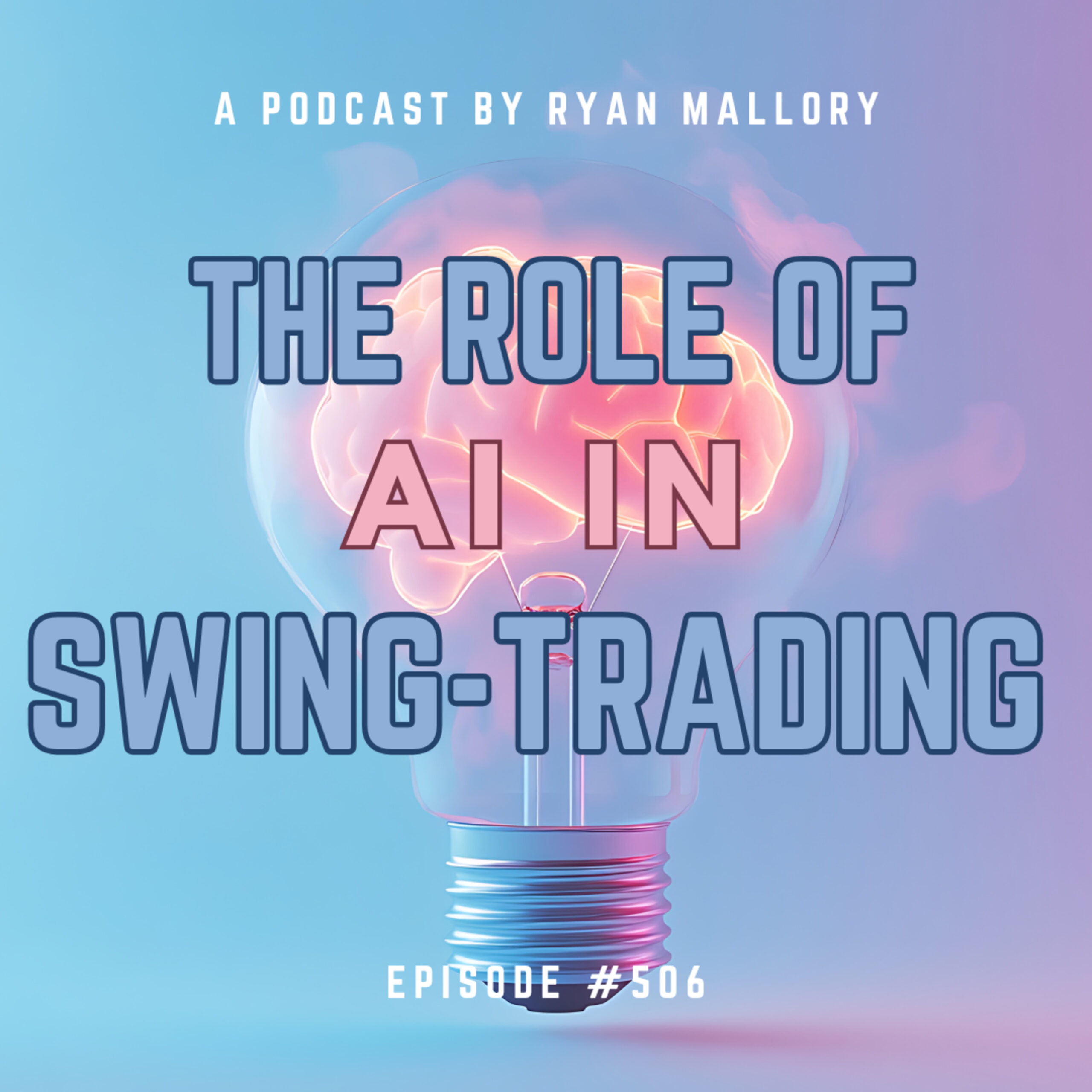
Episode Overview
AI is quickly overtaking our everyday life, and in the process changing how we live our life too. But how does AI impact swing trading and what can we use AI for in order to better enhance our trading returns, and perhaps make it a little bit easier too? In this podcast episode, I cover how AI is impacting swing traders, and what it means for the stock market going forward.
Available on: Apple Podcasts | Spotify | Amazon | YouTube
Episode Highlights & Timestamps
- [0:02] Introduction to AI in Trading
Ryan discusses how AI fits into swing trading and whether it can truly enhance a trader’s performance. - [2:13] Where AI Adds Value
He explains how AI can help with screening, coding, and learning trading concepts, making complex tools more accessible to everyday traders. - [8:53] The Problem with Emotionless Trading
Ryan discusses why AI’s lack of fear and greed can be a disadvantage, emphasizing the importance of human instincts in managing risk. - [13:20] Why AI Struggles with Strategy Creation
He breaks down the limitations of AI-generated strategies, including curve fitting, lack of uniqueness, and widespread duplication. - [19:36] Final Verdict on Using AI in Trading
Ryan concludes that while AI can assist traders, it should never replace personal responsibility or decision-making in managing trades.
Key Takeaways from This Episode:
- AI Is a Tool, Not a Trader: AI can assist with coding, research, and education, but it should not be trusted to fully manage trades or portfolios.
- Human Emotion Has Value: Fear and greed, when controlled, help traders avoid catastrophic risks and maximize gains in ways AI cannot replicate.
- Beware of Curve-Fitted Strategies: AI-generated strategies may look perfect in theory but often fail in real-world conditions due to over-optimization.
- Information Limitations Matter: AI is only as good as the data it receives and may lag behind real-time market developments.
- Responsibility Stays With You: No system, AI or human, will ever care about your money as much as you do, so decision-making must remain personal.
Resources & Links Mentioned:
- Swing Trading the Stock Market – Daily market analysis, trade setups, and insights by Ryan Mallory.
- Join the SharePlanner Trading Block – Get real-time trade alerts and community support.

Take the Next Step:
✅ Stay Connected: Subscribe to Ryan’s newsletter to get free access to Ryan’s Swing Trading Resource Library, along with receiving actionable swing trading strategies and risk management tips delivered straight to your inbox.
? Level Up Your Trading: Ready for structured training? Enroll in Ryan’s Swing Trading Mastery Course, The Self-Made Trader, and get the complete trading course, from the foundational elements of trading to advanced setups and profitable strategies.
? Join the Trading Community: Sign up for SharePlanner’s Trading Block to become part of Ryan’s swing-trading community, which includes all of Ryan’s real-time swing trades and live market analysis.
Full Episode Transcript
Click here to read the full transcript
0:02
Hey, I’m Ryan Mallory and this is my Swing Trading the Stock Market podcast. I’m here to teach you how to trade in a complex, ever changing world of finance. Learn what it means to trade profitably and consistently, managing risk, avoiding the pitfalls of trading, and most importantly, letting those winners run wild.
0:19
You can succeed at the stock market and I’m ready to show you how. Hey everybody, this is Ryan Mallory with shareplanner.com. Swing Trading the Stock Market in today’s episode promises to be a good one. We have a e-mail that is asking about the role that AI plays with swing trading.
0:38
So what does that look like into the future? What kind of significance? Because it it’s going to play a role to some degree. So what does that role look like as it pertains to trading and swing trading successfully? Is it expected that it’ll be able to enhance our trading? That’s what we’re going to talk about here.
0:55
So this e-mail comes from a guy who gets off with the wrong foot with me right out of the gate. Like couldn’t start off an e-mail any worse and you’re about to find out why. So in retaliation, I’m going to give him the worst Florida redneck name that was ever created. And that comes in the form of Budnick.
1:12
And Budnick, if you remember some of you guys that were born in the 80s, there was a show on Nickelodeon called Salute Your Shorts. Everybody watched it back in the early 90s. I love that show. And I only think it was like for a couple seasons. But there was this guy, he had to have been a Florida redneck.
1:27
His name was Budnick. That’s that’s what I’m giving this guy the name of Budnick here today. So Budnick writes. Hi, Brian. And that’s where he loses me. You can’t call Ryan O’Brien and he does. You know what though, I feel like the the penalties severe enough to be called Budnick on this podcast episode that you know, I’m sure this Budnick learns his lesson here.
1:52
So he writes, I’m a long time listener of Swing Trading the Stock Market. Really, really appreciate how you keep the focus on discipline, risk management, and realistic expectations. I was hoping you could do an episode on the role AI will play in swing trading, especially as tools like machine learning tools, AI scanners, and automated analysis becomes more accessible to retail traders specifically.
2:13
I’d love to hear your thoughts on where AI actually adds value for swing traders today. Screening, analysis, journaling, etcetera. Where it’s mostly hyped or potentially dangerous? Whether AI can realistically help with entries and exits, and if discretion still matters the most.
2:31
House swing traders can use AI without overfitting, curve fitting or relying on black box signals. And what you think the next few years will look like for an AI assisted trading versus fully automated systems. There’s a lot of excitement around AI right now, but also some confusion.
2:46
I’d appreciate your grounded risk focus perspective on how or if swing traders should be incorporating it into their process. Thank you for all you do and keep the for keeping the podcast so practical and honest. Best regards, Budnick.
3:03
All right, Budnick had to go. Call me Brian, man OK, So what is what is swing trading look like with AI? That’s that’s the big question, you know, and, and everyday AI is becoming more advanced. It’s like the early days of the Internet where web pages were becoming more and more powerful.
3:25
They were becoming more and more just visually appealing and, and you were, you were just seeing like, you know, sites move from Geo sites to, if you remember that back in the day to where it was just very professional. Like today you don’t have a professional blog or if you’re a Blogger and this doesn’t look professional, nobody’s going to really look at it.
3:44
So what does trading look like with AI? That’s the question to be had here. And it, it’s really in the early developments to where you’re seeing such groundbreaking improvements on a daily basis. Sometimes I’ll play around with the videos.
3:59
You can take a picture now and make a video out of it and it’s pretty cool. I’ll, I’ll use Gronk for that. And I, I hadn’t done it in a while and it, and like it within a couple of months. The difference between what it was like a couple months ago between now in terms of speed, in terms of quality and, and realism was impressive.
4:17
So I, I think that that it’s only going to get more faster and, and, and more groundbreaking. I also think about, you know, like personal computers, when they first started coming out and how quickly they were, they were improving.
4:36
You would buy like a computer for like $1500 back in the the late 90s. And it was kind of like driving a car off the lot. It already lost half of its value because by the time you got it home, there was already the new model out that was bigger, faster and stronger than the previous model.
4:54
And that’s what we’re seeing with AI right now. You’re seeing new chips, you’re seeing new technologies, you’re seeing new ways to employ AI. So while I’m doing this episode now, I hope that it stays relevant for a long time. But if it doesn’t, it’s probably because it, the technology has changed as much as it as it has.
5:16
But I do think that there’s some broader principles that we can take from it that I do think will be useful. So there’s a lot of goods and there’s a lot of bads when it comes to to AI being incorporated into our swing trading and just trading in general.
5:41
For one, there’s there’s a lot of stuff that you can cut out in the middle in terms of like if you’re trying to code for a Screener. Like for instance, Thinkorswim has their own in house code. I’ve never bothered to learn it, but now using their screening using AII, can I can use that screening and write my own codes using their, their, their, their coding language.
6:03
Before I would never been able to do that. Now I haven’t actually done that yet, but I know some people that have they’ve created special moving averages or indicators using the Thinkorswim coding that they don’t even know anything about.
6:20
I know for me personally, there was one time, you know, my, my website, shareplanner.com, it was started in 2007 and it’s changed a lot over the years.
6:35
I simply would like copy and pasted the code that it gave me, put it back onto the web page and it was, it was essentially like an Excel spreadsheet.
6:56
Now, back in the day, if I would have come across something like that before AI, you know, I would had to find somebody that recognized what the coding was, knew what it was.
7:15
If you have an idea or you have like a idea that you want to back test, but you don’t necessarily know how to write the code for it, you could rely on AI to be able to do that for you.
7:35
I don’t have a computer science degree, so sometimes when I’m writing screens, I’ll actually use AI to help me develop it so I know what the exact language to put into that particular software that I’m using.
7:55
The other one is often times you’ll come across questions you don’t understand something like I get people asking me questions about my charts.
8:13
And it’ll break it down to them in the most simplest of forms and probably do a far better job than most humans could do it and explaining it.
8:36
And then just for building knowledge, I think, you know, in, in general, the knowledge base that that you can, you can develop just learning about those indicators and learning about the basics of, you know, what a chart looks like, what it means and so forth. It can be good for that.
8:53
Now there’s a lot of bad too. And, and one of them that I would say is, is that the emotions. Now we always hear about how emotions are bad in trading, but there needs to be some emotions. You know, we talk about fear and greed there. There needs to be a certain baseline of it.
9:08
It’s when that that emotion can’t be controlled that can be concerning. There’s things that I’m legitimately afraid of in the market and it’s why I don’t trade it for one VIX volatility index and I won’t trade it. I will stay away from it.
9:24
Why? Because I have a good fear of what it can do to a portfolio. It can absolutely blow up your portfolio. And I think greed in the right places can be very good at that’s where you can get some of your most outlandish gains is by being just enough greedy.
9:40
So for me and my trading, I’ll take a 1/3 early on and I’ll take another third and then I’ll usually get to that last third of my trade or a last quarter of a trade, depending on where I’m at with the trade. And I’ll let that right as long as possible.
10:00
I won’t take any profits on it until there’s enough of a pullback to suggest that the narrative on that trade has changed. And that’s, that’s because I’m letting some greed play out in my trades. But I’ve I’ve managed to risk well enough to where it’s in a well, it’s in a good enough situation to let that play out.
10:21
Now, greed is bad. If you’re going 150% long on a stock and you’re saying I’m going to let it ride and then all of a sudden that’s that’s misplaced greed. That’s really bad greed.
10:47
Now, the reason why I’m talking about fear and greed is because AI shows no concern about fear or greed. It’s doesn’t have emotions, it doesn’t have a soul, it doesn’t feel things.
11:07
And that can be one of the drawbacks is that it’s not going to have that, you know, like when when they tell you like, hey, you know, if that the hair on the back of your neck starts to stand up, you know, that’s, that should be a warning sign that you should probably get out of a bad situation.
11:26
Like if you’re out in the middle of the night and you’re walking down a dark alley and all of a sudden you get that, that weird feeling. Yeah, AI is not going to get that weird feeling. AI is not going to be like coming on your phone and say, hey, the the electrodes on the on the back of my motherboard just, you know, shot up.
11:43
And I don’t know if you’re in the best position situation right now. You need to get yourself out now. And it’s the same thing like we as humans, we have some intrinsic almost at times, like unexplainable natural instincts that can come about that can tell us, hey, this isn’t the right situation or hey, you know, you need to get out of this trade.
12:02
And I’m not saying that anytime you have like a fear or an emotion, that means that, you know, you dump your positions or whatever. But AI doesn’t have a grasp of emotions. AI doesn’t know what it’s like to blow up an account or the aftermath of what it means to blow up your account.
12:18
It might know, OK, if you blow up your account, you’re going from 100,000 to a 0 or 1,000,000 to a 0, or even, you know, 100,000 to 10,000 is still blowing up your account. But it what it does, it may know what that means, but it doesn’t really know what it means to life.
12:44
It doesn’t mean know what it means when you have to explain to your wife why all of a sudden you’re 90% poor. It doesn’t explain to your kids why Johnny can’t you know, do baseball or soccer or whatever it might be. It has impact. It has emotional tolls and, and, and there’s, there’s reasons why we don’t take crazy risks.
13:02
There’s reasons why we don’t overload our portfolio when the market is looking more uncertain than ever before. It’s because we have these intrinsic emotions and qualities about us as humans that helps us to recognize things that we should not be doing that.
13:20
Hey, this is not a a risk that I can afford to take. And so you look at like my own trading system, all of it’s built around what kind of risk I can personally afford to take. And I know what those risks are. I know it from a position size. I know it from a stop loss standpoint.
13:39
I know on how I manage my profits and how I let let trades ride. I know what kind of stocks I’m willing to trade. I know what stocks I will not even go towards. Like what I said, the VIX products won’t even touch them because I understand it.
13:56
Now you can say, Ryan, you can just go ahead and eliminate those from your trading. But it goes beyond just saying, hey, don’t do ABC or XY and Z. It also entails having that internal compass that guides you in the right direction as well.
14:17
What about trading strategies? You know, can it create a good trading strategy? It’s possible. I don’t have a lot of confidence in that right now because again, I think there’s a lot of things that go into it beyond just the objective.
14:37
Give me a good trading strategy. And like what Budnick said in his his e-mail, there’s going to be times where if you asking for a strategy, they’re probably going to, it’s probably going to curve fit it to you.
14:53
You know, it’s just going to base all of it, you know, tight curve fit to where it looks like it’s a perfect strategy, But in reality it’s it’s impractical.
15:13
Also, if you go back and what this is probably a great movie to watch. I remember seeing a movie a long time ago with Joaquin Phoenix. It was called her and it was about this guy that was like falling in love with this AI on his phone. It like he would talk to the and have like conversations and weird conversations at that. But then he asked the AI and if I remember this correctly, asked the AI, like, are you talking to other people too? And I said, yeah.
15:39
And then it kind of like soured him on the whole thing because all of a sudden he realized this thing’s just having conversations with me because I, I bought it and because it, that’s what it’s kind of obligated to do. But it’s having the same kind of conversations with thousands or millions of other people all around the world. The point is, is that if you’re asking it for a strategy, there’s probably 10s of thousands of other people asking it for a strategy. And in the process, there’s probably going to be a lot of overlap in it.
15:59
It’s going to tell you based off of what its language models and what it knows from the Internet of what to give you. And you can even say, Hey, give me a unique strategy. There’s a good chance it’s not going to give you a unique strategy. So I think that’s, that’s one of the major downfalls. And I think that if it does come up with a good strategy, it’s probably going to log that as a good strategy and give that strategy to everybody else.
16:17
Even if you tell it the pinky promise and not tell anyone, it’s going to tell everyone. So I don’t think that you can rely on it to provide you with good strategies. And there’s the also the, and I think this will probably get better over time is the lagging information. It only a lot of times it’s not going to know like if there is an announcement that comes out in the next 5 minutes and then in 5 minutes and one second, good chance it doesn’t know that happened.
16:35
Or even in the next 10 minutes, it won’t be relying on the information that might have just happened within the last five minutes. It’s just there’s a lagginess to what in fact, when ChatGPT first came out, I think it was like two or three years behind on its information and it a lot of them are getting closer and being up to speed, but I wouldn’t necessarily trust it right out of the completely right now. I think that will get better over time, but I don’t know if it’ll fully be real time based.
16:50
And the other thing is that that AI is only as good as the information that’s being fed. So you heard that expression, expression of a tree falls in a forest and nobody hears it. Did it actually make a sound?
17:10
And that’s kind of how it is for AI. If, if XY and Z, if there’s this big, you know, natural disaster that happens, but nobody tells AIAI doesn’t know that it happened. It it it’s not like necessarily got eyes and ears out there for it.
17:28
And the and the point is, is that it’s only as good as the information that is being provided. So there is it, there’s still a human element, no matter, no matter what we think. And like I said, it’s never going to know what it’s like to blow up account. It’s never going to understand the risks that come with a stock market. It’ll tell you that it’s not a financial advisor and all that stuff, but it won’t understand inherent risks, the stress, the anxieties that we go through as traders, as humans trying to be profitable and conquering the market. And like I said, it’s not going to understand the stresses of life either.
18:01
One of the things though that I think can be helpful and goes beyond AI is the self-made trader. This is my very extensive and in depth training course that I’ve created over the last four years and just recent released and I think it will be a great asset for your learning and for your development.
18:17
With this course. You’re going to get a lot of information. You’re going to get everything that I know from the very beginning of basics of trading through my advanced strategies. It’s over 100 modules and over 25 hours of video learning with me.
18:38
And I take you from the very beginning basics, like I said, all the way through my more advanced strategies, managing trades, getting into trades, finding those trade setups, how to manage the risk side of it, profit taking and, and everything in between. So it’s a really a really good course. Highly recommend you check it out by going to shareplanner.com, clicking on Academy and you’ll see all my training courses right there. But definitely check out the self-made trader.
18:57
So I think we’ve, we’ve really covered a lot right here. I think that as we see more AI come into the picture, there’s going to be more need for human input. And what I mean by that is that if AI just keeps creating articles and keeps creating content, there’s going to become a time to where what that comes at a premium is the human touch.
19:18
What what comes as like the the most important thing is did a human create this or did AI? Because we’ll start to dismiss the whole AI and long for the days where humans are writing articles and they were providing their inputs. Because in the end, we don’t necessarily want AI to tell us what to think or, or what to believe or, or tell us how to live our lives.
19:36
But having that human interaction, whether it’s just reading somebody’s blog, but knowing that it was written by human, that they put their their thoughts, they put their heart into that article will make a big difference one day down the road. So I don’t think that all news and all information’s going completely the way of AII think a large portion of it will.
19:55
But I think really the gold mine’s going to be where you’re not necessarily relying on AI to feed you everything, but you can find those pockets of people. And, and, and it’s not just in trading, but in, in all industries that, that still let a human play a role in the information that you’re getting. And I think that’s going to be key going forward.
20:12
So in the end, I don’t think you can trust AI to just autopilot your trades. I don’t think you want to just trust AI because AI can, especially right now, it can goof up. It can give you some horrific ideas. Some horrific. Strategies and it just even in general, it can give you some horrible, horrible ideas.
20:27
And whether it’s AI strategies or financial advisors, you’ve heard me say this on on this podcast many a times. Financial advisors will never care about your money the way that you care about it. Yes, they want your money. They want to manage your money. But as soon as they get your money, what do you think they’re doing? They’re looking to get somebody else’s money. And so that’s why you see them so many times out on the golf course in the middle of the day.
20:46
They, they only care about that your money until they have it in your portfolio. And then they’re looking to get somebody else’s money. And it’s the same thing with AI is that they will, you’ll never see AI care about your money or how you manage the trade or about your capital the way you care about it yourself. So don’t delegate that to AI. Can it assist you and help you like what we talked about in the beginning? Absolutely. And you can grow as a trader from it, but don’t depend on it solely.
21:02
If you enjoyed this podcast, and I hope that you did, please make sure to leave me a five star review on whatever platform you’re listening to me on. If it’s on YouTube, make sure to like and subscribe. And make sure to send me your questions, ryan@shareplanner.com. I do get your emails. I read all of them and it’s only me that sees them. And I will never use your real name. That’s why we do Florida rednecknames anyways. But yeah, send me your emails, send me your questions.
21:20
Let me know what your story is and remember what is it profit a man if he gains the whole world but loses his own soul in the end. Swing trading is great, but Jesus Christ is more important. Thank you and God bless. Thanks for listening to Swing Trading the stock market.
21:42
If you’d like to trade alongside me each day, I invite you to join the SharePlanner Trading Block where I navigate the markets in real time with traders from around the world. Your membership includes A7 day trial and full access to my Discord trading room. You can Sign up today by visiting shareplanner.com/trading Block.
21:59
Be sure to follow SharePlanner on YouTube and X and across all major social platforms where I share unique market insights every day. And if you have any questions, feel free to reach out to me directly at ryan@shareplanner.com. All the best and I look forward to trading with you soon.
Enjoy this episode? Please leave a 5-star review and share your feedback! It helps others find the podcast and enables Ryan to produce more content that benefits the trading community.
Have a question or story to share? Email Ryan and your experience could be featured in an upcoming episode!
Become part of the Trading Block and get my trades, and learn how I manage them for consistent profits. With your subscription you will get my real-time trade setups via Discord and email, as well as become part of an incredibly helpful and knowledgeable community of traders to grow and learn with. If you’re not sure it is for you, don’t worry, because you get a Free 7-Day Trial. So Sign Up Today!

Welcome to Swing Trading the Stock Market Podcast!
I want you to become a better trader, and you know what? You absolutely can!
Commit these three rules to memory and to your trading:
#1: Manage the RISK ALWAYS!
#2: Keep the Losses Small
#3: Do #1 & #2 and the profits will take care of themselves.
That’s right, successful swing-trading is about managing the risk, and with Swing Trading the Stock Market podcast, I encourage you to email me (ryan@shareplanner.com) your questions, and there’s a good chance I’ll make a future podcast out of your stock market related question.
Refusing to take a loss when the trade has turned, and the reason for getting into the trade in the first place is no longer valid, is one of the biggest problems traders face. In this video, Ryan Mallory discusses the pitfalls that comes with refusing to take the loss and instead opting to become a bagholder on one's trades.
Be sure to check out my Swing-Trading offering through SharePlanner that goes hand-in-hand with my podcast, offering all of the research, charts and technical analysis on the stock market and individual stocks, not to mention my personal watch-lists, reviews and regular updates on the most popular stocks, including the all-important big tech stocks. Check it out now at: https://www.shareplanner.com/premium-plans
📈 START SWING-TRADING WITH ME! 📈
Click here to subscribe: https://shareplanner.com/tradingblock
— — — — — — — — —
💻 STOCK MARKET TRAINING COURSES 💻
Click here for all of my training courses: https://www.shareplanner.com/trading-academy
– The A-Z of the Self-Made Trader –https://www.shareplanner.com/the-a-z-of-the-self-made-trader
– The Winning Watch-List — https://www.shareplanner.com/winning-watchlist
– Patterns to Profits — https://www.shareplanner.com/patterns-to-profits
– Get 1-on-1 Coaching — https://www.shareplanner.com/coaching
— — — — — — — — —
❤️ SUBSCRIBE TO MY YOUTUBE CHANNEL 📺
Click here to subscribe: https://www.youtube.com/shareplanner?sub_confirmation=1
🎧 LISTEN TO MY PODCAST 🎵
Click here to listen to my podcast: https://open.spotify.com/show/5Nn7MhTB9HJSyQ0C6bMKXI
— — — — — — — — —
💰 FREE RESOURCES 💰
— — — — — — — — —
🛠 TOOLS OF THE TRADE 🛠
Software I use (TC2000): https://bit.ly/2HBdnBm
— — — — — — — — —
📱 FOLLOW SHAREPLANNER ON SOCIAL MEDIA 📱
FACEBOOK: https://facebook.com/shareplanner
*Disclaimer: Ryan Mallory is not a financial adviser and this podcast is for entertainment purposes only. Consult your financial adviser before making any decisions.
You Might Like

South Korea: The Hidden Driver of US Tech Volatility
Stop Trying to Hit Home Runs: Start Trading Within Your Means
How to Trade Breakouts Without Getting Trapped