
Episode Overview
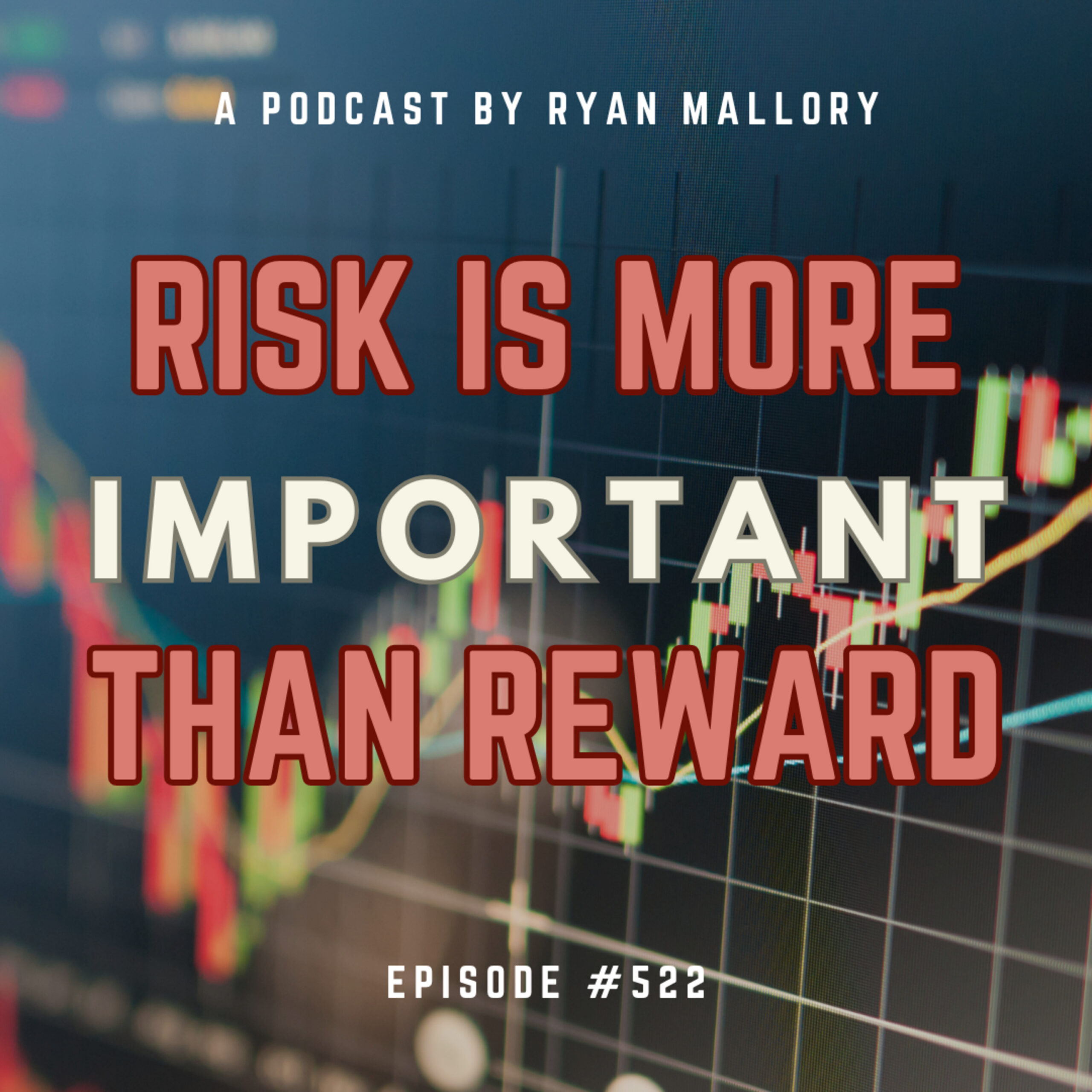
In this podcast episode, Ryan Mallory talks about just how important risk is as a factor in one’s trading, and how it trumps any potential profit opportunity that exists with a swing trade.
Available on: Apple Podcasts | Spotify | Amazon | YouTube
Episode Highlights & Timestamps
- [1:50] Understanding Risk and Reward
Ryan explains the two possible outcomes in every trade, either the risk gets hit or the reward is reached, and how that creates the reward risk ratio. - [3:04] Why Wider Stops Require Bigger Rewards
Ryan discusses how risking 10% or 20% on a trade requires a much larger upside target in order to justify the trade. - [6:39] Avoiding Dollar Based Decisions
Ryan explains why he focuses on R multiples instead of dollar amounts so personal emotions do not interfere with trading decisions. - [11:57] The Four Trading Scenarios
Ryan lays out the difference between low risk, high reward, low risk, low reward, high risk, high reward, and high risk, low reward setups. - [15:39] Why Bad Habits Form in Bubbles
Ryan warns that traders can be rewarded for bad risk behavior during bubbles, but those habits often lead to major losses when market conditions change.
Key Takeaways from This Episode:
- Risk Comes First: Traders should focus on the amount they are risking before getting excited about the potential reward.
- Two to One Still Matters: Even if a trade does not always reach a two to one return, the setup should at least have a realistic path to that kind of reward.
- Avoid Personalizing Profits: Looking at trades in dollar amounts can cause emotional decisions that have nothing to do with the market setup.
- Not All Rewards Are Worth the Risk: High reward trades can still be dangerous when the risk is too wide or poorly defined.
- Bubbles Reward Bad Behavior Temporarily: A trader can make money with poor risk management in a bubble, but that behavior is usually not sustainable.
Resources & Links Mentioned:
- Swing Trading the Stock Market – Daily market analysis, trade setups, and insights by Ryan Mallory.
- Join the SharePlanner Trading Block – Get real-time trade alerts and community support.

Take the Next Step:
✅ Stay Connected: Subscribe to Ryan’s newsletter to get free access to Ryan’s Swing Trading Resource Library, along with receiving actionable swing trading strategies and risk management tips delivered straight to your inbox.
? Level Up Your Trading: Ready for structured training? Enroll in Ryan’s Swing Trading Mastery Course, The Self-Made Trader, and get the complete trading course, from the foundational elements of trading to advanced setups and profitable strategies.
? Join the Trading Community: Sign up for SharePlanner’s Trading Block to become part of Ryan’s swing-trading community, which includes all of Ryan’s real-time swing trades and live market analysis.
Full Episode Transcript
Click here to read the full transcript
0:02
Hey, I’m Ryan Mallory and this is my Swing Trading the Stock Market podcast. I’m here to teach you how to trade in a complex, ever changing world of finance. Learn what it means to trade profitably and consistently, managing risk, avoiding the pitfalls of trading, and most importantly, letting those winners run wild.
0:19
You can succeed at the stock market and I’m ready to show you how. Hey everybody, this is Ryan Mallory with shareplanner.com. Swing Trading the Stock Market. In today’s episode, we’re going to talk about how risk is greater than reward. Not necessarily on a trade to trade basis where we’re saying that the risk is always greater than the potential reward, but the fact that we consider risk to be a greater element or variable when it comes to trading than the potential for reward.
0:48
Now, I usually do emails, I’ll take an e-mail from you guys and I will talk about what the concern or what the problem is that a particular listener is having when it comes to trading. But in this episode, and I do this from time to time, I I shake it up a little bit and I just talk about a issue or a topic that is pertinent to trading at this particular moment.
1:12
And when you look at the market that we’re currently in where we’ve had this remarkable rally off of those, I mean, the S&P 500 is up 20% since the the March low. I don’t think anybody necessarily thought we were going that high or even thought that was even a possibility. But here we are. It happened.
1:28
And So what you’re seeing is a very concentrated move. It’s all in the tech, the AI space and you’re seeing a little bit more in the software, even though software had been pummeled for quite a while. Software is starting to really add some gains to the overall market too. So when it comes to trading, what we want to think about here is that there is 2 outcomes that can be had in your trade.
1:50
The first one is the risk gets hit. OK, that’s, that’s the risk element. Risk gets hit, the stock goes down, you get stopped out. The other is that the reward is hit and that is where the stock goes up. You play a breakout and it goes from, let’s say $100 to $115 and then you get out and you, you take the reward.
2:09
So out of that evolves the reward risk ratio. And with the reward risk ratio, you’re measuring how much potential reward is there versus the amount that you’re risking. And when you think about what you’re risking on a trade, it comes in all shapes and sizes for different people.
2:25
There’s earnings risk, which I won’t play, others will, and that’s fine. I I think it’s a little bit crazy to play the risk because there’s so much or put to play earnings because there’s so much risk that can be had from it doesn’t feel like that right now when you’re seeing earnings like like snow or like Dell where they’re going up 35 to 40% on post earnings for a beating expectations.
2:48
But but it is a, it is a risk. But really for, for this particular topic, I’m talking more about the amount that we’re willing to risk on a trade. So you get into a stock at $100 and you’re saying to yourself, OK, I see some, some key support at $95.
3:04
I’m willing to risk 5% on this trade. That what I’m really talking about. Now for people though, it, it comes in different sizes. We can say, well, we like risk at 7 1/2 percent or 10%. But the wider that you get that risk, the the more profitable you have to be on the reward side.
3:25
So if you risk 10% on the trade in order to justify a 2 to one return, you need to get to or 20%. If you are one that takes 20% losses or are OK with a 20% loss on your stop loss, then you need to make sure that there’s a pathway to 40% higher.
3:45
And what’s crazy is in this market right now, there is pathways to 40% you, I mean, typically you have to hold through earnings or you’re in Micron or AMD or INTC. But you just saw it this past week where within one to two days post earnings, stocks like Dell and Snowflake that I just mentioned goes up 35 to 40%.
4:07
And, and it’s so it feels like it. And I think this is where when you get into these kinds of markets, so you get a lot of misplaced confidence where traders are like, hey, I know what I’m doing here. I’m going to quit my job or I’m going to, you know, start trading like this full time. I’m going to create my spreadsheet that shows if I do this over, you know, the next five years, I’ll be the world’s first trillionaires.
4:27
And so they just keep, you know, building, building this belief that what they’re going through right now is normal. And it’s not. It’s very much a bubble. It doesn’t mean that it can’t be profitable or that it can’t keep running higher. But we are in a bubble, no doubt about that.
4:43
And at some point it will bust, but until then, you know, we’re we’re dealt with the hand that we were giving in this market. And it’s a very difficult 1 outside of tech, Outside of tech, you know, you look at real estate, you look at discretionary, discretionary starting to move here of late, but you look at industrials, materials, utilities, healthcare, healthcare starting to break out a little bit here.
5:07
But by and large, you know, for months now, couple months, it’s, it’s been pretty rough sledding, even though the market is balanced. And so you just look at any of the end sectors outside of tech and then the, the subset sector of software and, and semiconductors, there’s really not a lot to, to work with.
5:26
And so it’s imperative in our trades that we look for opportunities that’s more than two to one in our setups. Now, will you always achieve 2, two to one? And your trades like is no, no, it’s not. I mean, you should be achieving it. You know, I would say, you know, a good chunk of the time, but you’re not going to necessarily achieve it every time.
5:50
And that’s the reason why the 2 to 1 still matters even if you don’t achieve it is because you want to make sure that you’re getting into a trade that has a pathway to to getting twice as much in terms of reward as you get for your risk. Because if you don’t, then let’s say you’re constantly only getting like .2 or a half of what you in rewards versus what you risk.
6:15
Well then if you’re right, you know, 5055% of the time you’re unprofitable as a trader. So it’s imperative that you’re looking at getting into your trades, you know, with a 2 to 1 edge. And like I said, you won’t always achieve that 2 to 1 edge, but but that should be the what you’re looking for on, on the trades that you get into.
6:39
So one of the things that I, I look for in my trades, I don’t, and I think this is where I diverge from a lot of people in when it comes to trading. People look at dollar amounts, you know, it’s like I’ll risk $100 or I’ll risk 1000 or 10,000 on this trade. I don’t look at the dollar amounts. I don’t even look at dollar amounts throughout the year on an individual trade, how much I’m up on the year.
6:57
I don’t look at any of that. And the reason why I don’t is because I don’t want to be influenced by the dollar amount. And so if you let yourself be influenced or if you look at the dollars, there’s a very good chance that your, your decision making is going to be based on those dollars. Because then you start personalizing what those dollars mean to me or to not just to me, but to anybody.
7:15
And especially especially true for me because, you know, you can look at things like, well, that’s a mortgage payment or that’s my kids college tuition for the fall or, or I could get magic season tickets or Astro season tickets with that money. But you you start personalizing it and then you start making it a trading decision where you’re like, Oh, it’s up a full season tickets of Houston Astros.
7:38
I’m going to to sell my position because I’m going to take that money and put it towards that. That’s not what we can should be doing as trading as traders. We should be looking only at what the market cares about. And so when we start to insert personal variables into the mix, that’s where we start making bad decisions.
8:00
Because the that amount that you just sold for season tickets to your favorite baseball or football team could have been a whole lot more if you didn’t personalize it. It could have been that it had a lot more room to run, but because you started putting personal variables into the equation, you got knocked out of that trade. So I look at it in terms of R multiples, not in dollar amounts.
8:19
Now, I know that on most of my trades, I want to be somewhere around the three to 5% range for a stop loss. And so if I’m getting into a stock at $100 and I say, all right, my stop loss is at $95, that is my R multiple. OK? That’s that’s what the R multiple is going to be based off of.
8:39
Is that one on the risk? Now I want to make sure that our multiple is going to be like 2 or 3 or 4 to 1. And so when I get into the trade, there needs to be a pathway to to A2 multiple or to A2 or multiple. So that $5 that I’m risking needs to be able to have a potential target price of $10 higher.
9:07
If it doesn’t, then I’m going to move on from the trade because it’s not worth it for me if I’m going to get into a trade at $100 and there’s a massive layer of resistance right there at $102.00 because there’s a good chance, not a certain chance, but there’s a good chance that it’s going to hit that level and then pull right back.
9:26
Now you look at like Microsoft, for instance, this one had AAV WHAP going back to I think it was like October. And not everybody uses AV WHAP, but essentially it takes the average volume, the price for every share traded it, it gives a weighting to that based off of how many shares were traded at that price level.
9:54
And so you get this AV WAP that’s anchored to a specific price point. And then if you look at it going, I think it was the October highest of last year, it consistently pushed back on that. Now eventually on Microsoft AB the the resistance is going to break, but it’s the, the carnage that it creates for swing traders in the short term that if, if you can, if you try to get into it before it breaks above it, it, it, it can easily stop you out of your trade.
10:10
So that’s what you don’t you don’t want to have to take on is like a stock that you get into that doesn’t have a, a high risk ceiling or reward sealing. I mean, and then you get stopped out because it hit that resistance in a in a pullback and stopped you out. Microsoft had it and then today it breaks out above it.
10:37
And so that that’s got a clear runway to much higher prices. But before that there was serious resistance. Now resistance is made to be broken eventually in most cases. Now you get some that you know it’s they’re they’re on this like I would say if you take the inverse E TFS0S 0XS right, there’s a good chance that some of that resistance will never get broken and they’ll just especially with the time decay that’s that’s involved in it as well.
10:54
So that’s what goes into the multiplier. Now I’ll be remiss if I didn’t mention that the self-made trader The self-made Trader is a course that I created about a year ago. I released it a year ago. It took me about four years to make, but it’s an incredible course.
11:22
It’s about 25 hours of instructional videos that teaches you everything that I know about trading from the very beginning fundamentals to the my more advanced strategies. I’m going to take you from the very beginning concepts of everything that plays into who I am as a trader and the, the tactics, strategies, the mindset, the emotions and controlling those emotions versus building watch lists and scans and developing those watch lists and scans and, and managing the trades and finding trade setups and how to lay out the parameters of the trade.
11:38
If you like this podcast, this is going to teach you everything that goes into what makes this podcast so great as well. Because I’m I’m, I’m essentially teaching everything I know over the course of a 30 year period of trading that I’ve been that I’ve been doing this for.
11:57
So check that out. Go to shareplanner.com, click on the Academy and then you’ll be able to see the the self-made trader right there. So check that out. Appreciate that in the process, your support in this podcast. Now, ultimately there’s about four different scenarios when you get into your trading.
12:14
One is there is a low risk, high reward. That’s ideal. That’s what I want. And every one of my trade setups, if it doesn’t have it, I don’t get into it. Low risk, high reward. That means risking $1.00 to make $2.00. The risk is low, the the reward is high.
12:29
And if it’s at 3 to 1, even better. Four to one, yes, please. But what I want to avoid is the low risk, low rewards. That’s where you often get in times with like utilities and real estate stocks and staples, even at times. No, staples of late has not been that way.
12:46
I’ve actually even traded staples and and done fine with that. I mean, you look at Walmart and what it’s done, you should be. That was like a low reward, low risk setup, but you go back to like utilities and you go to a real estate and to a lesser degree some of the healthcare stocks, they can be low risk, low reward.
13:09
That means like you’re risking the risk is fine, but the reward is not. You’re risking $1.00 to make $1.00 or less. Maybe it’s a half a dollar. You don’t want that. You want to avoid low risk, low reward setups. That’s why often times I’ll look for betas over one just because if I, if I get the trade setup correct, that the reward will usually be a a much better return for you.
13:31
And so I look for those higher beta plays that are above 1, not below 1. And that’s where you’re a lot of your defensive stocks will fall is below 1. And then try to find those setups that have a manageable risk within my range. Another one that I, I try to avoid and I feel like this is what is quite common in this market right now.
14:04
And that’s the high risk, high reward trade. And it makes a lot of people complacent in their trades because the, the reward keeps getting hit, but there’s still a high risk to it. And so, you know, it may be one of those scenarios where you’re looking at like a $15 stop loss on $100 stock, but it’s good because it’s got, you know, $130.00 ceiling, but that’s still a very wide stop loss and you’re trying to get a, a huge reward out of it.
14:23
So then the other one would be high risk, low reward. And that would be where you’re getting, you know, you’re risking like 15% or 30% to make 5%. You don’t want to do that. That’s not a good scenario where you’re getting very low returns for the amount that you’re risking.
14:40
And so in this current market, like I said, high risk, high reward, that’s your tech sector, that’s semiconductors. That’s that’s why you got a lot of new people to trading who don’t understand the concepts to risk that are doing really well because they’re ignoring the risks and only focusing on the fact that wow, Micron moves up like 10% every day.
15:00
Yes, yes, get me into that. And they’re completely ignoring the the risk element of it because they don’t actually think that it exists or they don’t realize that it exists. And then everything else in the market is really like low risk, low reward, high risk, low reward, high reward, high risk.
15:22
And that obviously that’s, that’s more like in the tech in the, the semiconductor space. But what is not there is low risk, high reward. There’s some, there’s some that’ll get you like that. We had a guy actually a number of people in our discord that was able to jump on a HPEI didn’t do it, but they, they found a low risk, high reward setup and they did really good.
15:39
I think they’re up like 60% or something crazy like that. But, but just because there’s a, there’s a bad reward risk ratio and this is something else that a lot of people forget, doesn’t mean that the market won’t reward you.
15:59
Still the the problem becomes is that the market rewards you. But we as humans think that that’s going to be continuous. We start creating the spreadsheets that I was warned against because the spreadsheets, what gets you in trouble? If you’re creating spreadsheets, you’re probably going to blow up your account at some point because we extrapolate what the current trading environment means years and years into the future.
16:15
And we trade like that when the market conditions change. And so just because it’s a bad reward risk ratio doesn’t mean that you can’t still be rewarded on it, but the sustainability of that behavior and trading cannot last because eventually you’re going to blow up your account.
16:31
And it’s not going to be like, oh, I just had one bad trade. I’m going to step away. Sometimes it’s just one bad trade that does blow up your account, but you’ll see it as, OK, that was a one off scenario there. I’m going to get back on the horse and I’m going to get right back up to all time highs.
16:52
And then you continue that same behavior. And it’s not until that it really wrecks you that you realize this doesn’t work. It happened to me when I was in the 90s. You know, I got my start in I think 9191 with trading and I was, I was in mutual funds to gollyliterallythe.com bubble.
17:12
The similarities to it versus now is incredible because back then I was just like printing money for like a kid and I, I took 5000 and turned $50,000 into it and it was during again, a market bubble and it felt easy. In fact, my impression as a teenager was as stocks only go up, I mean, I was one of those people.
17:34
Like when it finally crashed, I mean, I lost well over half from its height. And that’s what made me start to think about the whole risk aspect of trading. Like I don’t ever want to be caught into that again. And so we’re in that moment again. I didn’t even think that necessarily we’d ever see anything likethe.com bubble and like the AI bubbles, like hold my beer, I’m going to blow it out of the water.
17:52
And it is. But there’s going to be a lot of people that are going to be telling a lot of stories about how much money that they had during the AI bubble, but they don’t have it anymore. And so even when the market conditions change, we still have to be thinking about the risk aspect first.
18:09
We have to be looking for a low risk, high reward. If we start getting sucked into the high reward, high risk trade setups, it’s only going to be a doom and gloom for our portfolios. And I’m not talking about, I’m not trying to be like, oh, the market top is in. I’m not saying that at all. For all we know it goes on for another few years.
18:25
But I’m looking at it from an individual trade standpoint that it the patterns and the habits that you develop right now are going to depend on how well you weather when the bubble does eventually blow up one day. So you want to make sure that you’re doing, even if it pains you.
18:42
And, and trust me, I’ve had trades that I don’t enjoy. I get them all the time. And but often times what, what I hate about it is that I have to adhere to my risk parameters. And it gets even worse when you get stopped out of the trade and you watch it go right back up. But in the end, you have to adhere to those because if you don’t, you’re not going to be doing it for long.
18:59
And so I want you to be able to survive the, the market like I have over the years. I’ve been doing it for a long time now. And sometimes you don’t get the all, all the meat and potatoes from some of these moves that you see unfold. And that’s because it’s not a low risk, high reward market.
19:19
And so the, the good setups that would constitute low risk, high reward are not out there. So keep that in mind. And in the end, you’re going to have to be willing to adjust to the different market conditions, but always adhere to your risk parameters, even if that means you have to miss out on some really good trades.
19:36
If you enjoyed this podcast, and I hope that you did, please make sure to leave a a like and subscribe. If you’re listening to me on YouTube, if you’re listening to me on one of the the podcast platforms like Spotify or Apple, leave a five star review. I really do appreciate those. They do mean the world to me and I would love to hear from you guys by sending me an e-mail, ryan@shareplanner.com.
19:55
I’ll use your e-mail in a future podcast like I’ve been doing for gosh, I think like 9 years I’ve been doing this podcast for. I’ve been doing podcasting for podcasting was cool, I guess. But yeah, I mean, this is my 520 second episode, so there’s definitely a lot of questions that I’ve answered and I would love to be able to answer yours.
20:11
So send me your questions ryan@shareplanner.com. And don’t forget to check out the self-made trader. Just go to shareplanner.com, click on Academy and you’ll get all of the information right there. And remember, Jesus Christ, He is the way, He’s the truth and he’s the life. Nobody comes to the Father except through him. Thank you and God bless.
20:30
Thanks for listening to Swing Trading the Stock Market. If you’d like to trade alongside me each day, I invite you to join the SharePlanner trading block where I navigate the markets in real time with traders from around the world. Your membership includes A7 day trial and full access to my Discord trading room.
20:47
You can Sign up today by visiting shareplanner.com/trading Block. Be sure to follow SharePlanner on YouTube and X and across all major social platforms where I share unique market insights every day. And if you have any questions, feel free to reach out to me directly at ryan@sharelanercom. All the best and I look forward to trading with you soon.
Enjoy this episode? Please leave a 5-star review and share your feedback! It helps others find the podcast and enables Ryan to produce more content that benefits the trading community.
Have a question or story to share? Email Ryan and your experience could be featured in an upcoming episode!
Become part of the Trading Block and get my trades, and learn how I manage them for consistent profits. With your subscription you will get my real-time trade setups via Discord and email, as well as become part of an incredibly helpful and knowledgeable community of traders to grow and learn with. If you’re not sure it is for you, don’t worry, because you get a Free 7-Day Trial. So Sign Up Today!

Welcome to Swing Trading the Stock Market Podcast!
I want you to become a better trader, and you know what? You absolutely can!
Commit these three rules to memory and to your trading:
#1: Manage the RISK ALWAYS!
#2: Keep the Losses Small
#3: Do #1 & #2 and the profits will take care of themselves.
That’s right, successful swing-trading is about managing the risk, and with Swing Trading the Stock Market podcast, I encourage you to email me (ryan@shareplanner.com) your questions, and there’s a good chance I’ll make a future podcast out of your stock market related question.
Watching the dollars rise and fall in your trading account can turn a well-planned swing trade into an emotional, deeply personal decision. In this episode, I explain why focusing on price action, percentage returns, and R-multiples can help you avoid cutting winners early, holding losers too long, and abandoning your trading plan.
Be sure to check out my Swing-Trading offering through SharePlanner that goes hand-in-hand with my podcast, offering all of the research, charts and technical analysis on the stock market and individual stocks, not to mention my personal watch-lists, reviews and regular updates on the most popular stocks, including the all-important big tech stocks. Check it out now at: https://www.shareplanner.com/premium-plans
📈 START SWING-TRADING WITH ME! 📈
Click here to subscribe: https://shareplanner.com/tradingblock
— — — — — — — — —
💻 STOCK MARKET TRAINING COURSES 💻
Click here for all of my training courses: https://www.shareplanner.com/trading-academy
– The A-Z of the Self-Made Trader –https://www.shareplanner.com/the-a-z-of-the-self-made-trader
– The Winning Watch-List — https://www.shareplanner.com/winning-watchlist
– Patterns to Profits — https://www.shareplanner.com/patterns-to-profits
– Get 1-on-1 Coaching — https://www.shareplanner.com/coaching
— — — — — — — — —
❤️ SUBSCRIBE TO MY YOUTUBE CHANNEL 📺
Click here to subscribe: https://www.youtube.com/shareplanner?sub_confirmation=1
🎧 LISTEN TO MY PODCAST 🎵
Click here to listen to my podcast: https://open.spotify.com/show/5Nn7MhTB9HJSyQ0C6bMKXI
— — — — — — — — —
💰 FREE RESOURCES 💰
— — — — — — — — —
🛠 TOOLS OF THE TRADE 🛠
Software I use (TC2000): https://bit.ly/2HBdnBm
— — — — — — — — —
📱 FOLLOW SHAREPLANNER ON SOCIAL MEDIA 📱
*Disclaimer: Ryan Mallory is not a financial adviser and this podcast is for entertainment purposes only. Consult your financial adviser before making any decisions.
You Might Like

South Korea: The Hidden Driver of US Tech Volatility
Stop Trying to Hit Home Runs: Start Trading Within Your Means
How to Trade Breakouts Without Getting Trapped