
When a major stock like Oracle (ORCL) pulls back 31% from its all-time highs, traders take notice. For many, a significant drop like this spells trouble. But for the disciplined trader, it can signal a prime opportunity. The key is to understand where the stock might find its footing, and right now, Oracle is testing a critical support level that could define its next major move.
While this steep decline in Oracle has been dramatic for those holding the stock, its impact on the broader market, like the S&P 500 (SPY) or Nasdaq 100 (QQQ), has been surprisingly minimal. This tells me the selling pressure is largely specific to ORCL, not a sign of widespread market panic. For traders, this isolation is a good thing and it means we can analyze the stock on its own technical merits without as much noise from overall market sentiment.
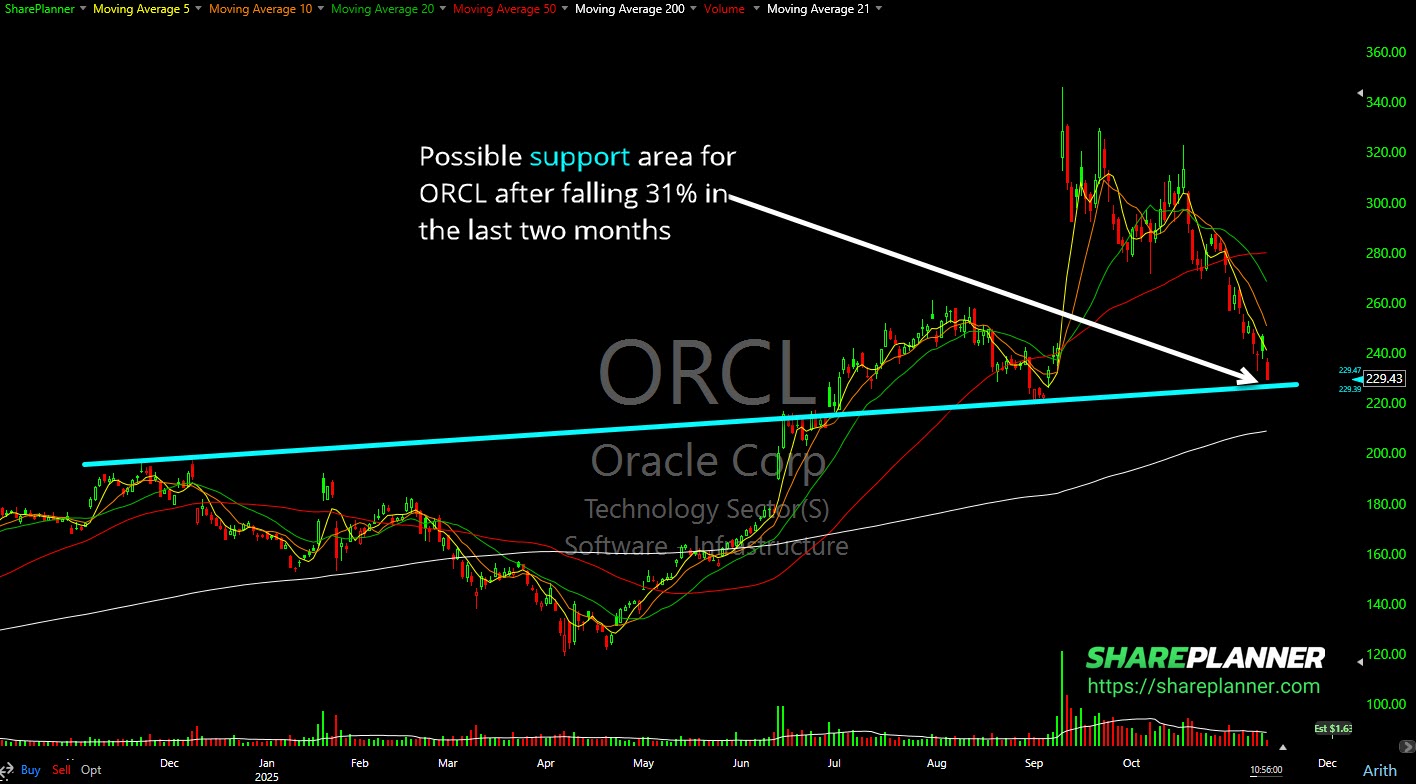
As you can see from the chart below, after peaking near $340 in October, the stock has been in a freefall. But it is now approaching a key support area around the $229 level. This isn’t just a random price; it’s a level where buyers have previously stepped in, creating a potential floor for the stock.
How to Trade This ORCL Setup
When a stock tests a key support level, there are a few ways to approach it. The goal isn’t to perfectly time the bottom as that is a losing game. Instead, we want to see confirmation that buyers are stepping back in and that the support level is holding strong.
Here are a few things to watch for:
- A Bounce Off Support: The most straightforward signal is seeing the stock price hit the support level (around $229) and then bounce higher. We’re not looking for a massive rally right away. A solid close above support for one or two days can be enough to show that the selling pressure is easing.
- Increased Buying Volume: Pay attention to the volume bars at the bottom of the chart. A bounce on low volume isn’t very convincing. What we want to see is a spike in buying volume as the stock tests support. This indicates that large institutions and other serious buyers are accumulating shares at this level, giving the support more credibility.
- Bullish Candlestick Patterns: Look for patterns like a “hammer” or a “bullish engulfing” candle right at the support level. These patterns can signal a potential reversal and show that buyers have successfully defended the price level during the trading day.
Managing risk is always the top priority. If you decide to take a long position here, your stop-loss should be placed just below the key support level. Why? Because if the stock breaks decisively below that floor, it’s a clear sign that the downtrend is likely to continue, and you want to get out with a small, manageable loss. Hoping for a recovery once key support is broken is how traders get into deeper trouble.

The Bigger Picture on ORCL
Oracle’s 31% decline is a significant event, but it’s not a reason to panic. For swing traders, volatility is where opportunities are born. The stock is now at a critical juncture, testing a support level that could serve as the launchpad for a new rally.
I’m not jumping in just yet. I want to see the stock prove itself. I’ll be watching for a confirmed bounce off support, backed by strong volume, before considering a long trade. If that happens, this could be one of the best dip-buying opportunities we’ve seen in a while. If it fails, we stay on the sidelines and protect our capital. It’s that simple.
Become part of the Trading Block and get my trades, and learn how I manage them for consistent profits. With your subscription you will get my real-time trade setups via Discord and email, as well as become part of an incredibly helpful and knowledgeable community of traders to grow and learn with. If you’re not sure it is for you, don’t worry, because you get a Free 7-Day Trial. So Sign Up Today!


Welcome to Swing Trading the Stock Market Podcast!
I want you to become a better trader, and you know what? You absolutely can!
Commit these three rules to memory and to your trading:
#1: Manage the RISK ALWAYS!
#2: Keep the Losses Small
#3: Do #1 & #2 and the profits will take care of themselves.
That’s right, successful swing-trading is about managing the risk, and with Swing Trading the Stock Market podcast, I encourage you to email me (ryan@shareplanner.com) your questions, and there’s a good chance I’ll make a future podcast out of your stock market related question.
Watching the dollars rise and fall in your trading account can turn a well-planned swing trade into an emotional, deeply personal decision. In this episode, I explain why focusing on price action, percentage returns, and R-multiples can help you avoid cutting winners early, holding losers too long, and abandoning your trading plan.
Be sure to check out my Swing-Trading offering through SharePlanner that goes hand-in-hand with my podcast, offering all of the research, charts and technical analysis on the stock market and individual stocks, not to mention my personal watch-lists, reviews and regular updates on the most popular stocks, including the all-important big tech stocks. Check it out now at: https://www.shareplanner.com/premium-plans
📈 START SWING-TRADING WITH ME! 📈
Click here to subscribe: https://shareplanner.com/tradingblock
— — — — — — — — —
💻 STOCK MARKET TRAINING COURSES 💻
Click here for all of my training courses: https://www.shareplanner.com/trading-academy
– The A-Z of the Self-Made Trader –https://www.shareplanner.com/the-a-z-of-the-self-made-trader
– The Winning Watch-List — https://www.shareplanner.com/winning-watchlist
– Patterns to Profits — https://www.shareplanner.com/patterns-to-profits
– Get 1-on-1 Coaching — https://www.shareplanner.com/coaching
— — — — — — — — —
❤️ SUBSCRIBE TO MY YOUTUBE CHANNEL 📺
Click here to subscribe: https://www.youtube.com/shareplanner?sub_confirmation=1
🎧 LISTEN TO MY PODCAST 🎵
Click here to listen to my podcast: https://open.spotify.com/show/5Nn7MhTB9HJSyQ0C6bMKXI
— — — — — — — — —
💰 FREE RESOURCES 💰
— — — — — — — — —
🛠 TOOLS OF THE TRADE 🛠
Software I use (TC2000): https://bit.ly/2HBdnBm
— — — — — — — — —
📱 FOLLOW SHAREPLANNER ON SOCIAL MEDIA 📱
*Disclaimer: Ryan Mallory is not a financial adviser and this podcast is for entertainment purposes only. Consult your financial adviser before making any decisions.

You Might Like

South Korea: The Hidden Driver of US Tech Volatility

Stop Trying to Hit Home Runs: Start Trading Within Your Means
How to Trade Breakouts Without Getting Trapped