

My Swing Trading Approach
No new positions for me added on Friday. Didn’t like the price action and chose to stay on the sidelines instead. This morning, I will be most interested in whether the bulls can hold the gap up, and I will be looking to add 1-2 new trades to the portfolio this morning.
Indicators
- Volatility Index (VIX) – Still unable to close at the highs of the day, however there is a fairly well defined inverse head and shoulders pattern that has developed and could see a break higher as a result.
- T2108 (% of stocks trading above their 40-day moving average): Not liking the overall look, especially if it loses the $45 level which would mark a lower-low being established. Currently sitting at 48% following Friday’s 6.3% sell-off.
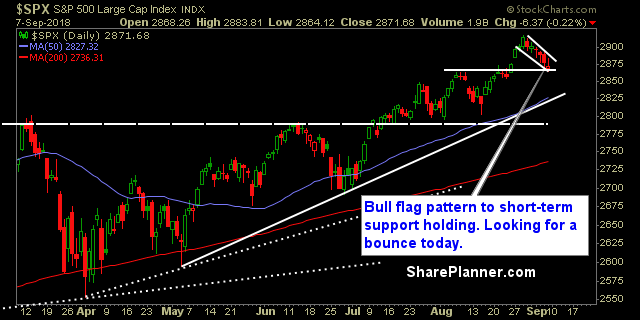
- Moving averages (SPX): Tested and held the 20-day mvoing average on Friday.
- RELATED: Patterns to Profits: Training Course
Sectors to Watch Today
No major winners on Friday, but Telecom did manage to bounce off of its 50-day moving average. Technology displayed relative strength by pulling back to the June lows and bouncing perfectly off of them. Looking for a good bounce out of them here. Healthcare in a bull flag pattern. Energy near the bottom of their recent channel – may see a breakdown here, folowing six straight days of selling. Utilties sporting a quasi bearish kicker pattern today and could also be forming a double top in the short-term. 
My Market Sentiment
The 20-day moving average and short-term support managed to hold strong for the bulls yesterday. Look for a bounce today.
S&P 500 Technical Analysis
Current Stock Trading Portfolio Balance
- 2 Long Positions


Welcome to Swing Trading the Stock Market Podcast!
I want you to become a better trader, and you know what? You absolutely can!
Commit these three rules to memory and to your trading:
#1: Manage the RISK ALWAYS!
#2: Keep the Losses Small
#3: Do #1 & #2 and the profits will take care of themselves.
That’s right, successful swing-trading is about managing the risk, and with Swing Trading the Stock Market podcast, I encourage you to email me (ryan@shareplanner.com) your questions, and there’s a good chance I’ll make a future podcast out of your stock market related question.
In this podcast episode, Ryan discusses how really bad, losing trades in the stock market creates an impossible scenario for the trader in terms of what the right decision should be.
Be sure to check out my Swing-Trading offering through SharePlanner that goes hand-in-hand with my podcast, offering all of the research, charts and technical analysis on the stock market and individual stocks, not to mention my personal watch-lists, reviews and regular updates on the most popular stocks, including the all-important big tech stocks. Check it out now at: https://www.shareplanner.com/premium-plans
📈 START SWING-TRADING WITH ME! 📈
Click here to subscribe: https://shareplanner.com/tradingblock
— — — — — — — — —
💻 STOCK MARKET TRAINING COURSES 💻
Click here for all of my training courses: https://www.shareplanner.com/trading-academy
– The A-Z of the Self-Made Trader –https://www.shareplanner.com/the-a-z-of-the-self-made-trader
– The Winning Watch-List — https://www.shareplanner.com/winning-watchlist
– Patterns to Profits — https://www.shareplanner.com/patterns-to-profits
– Get 1-on-1 Coaching — https://www.shareplanner.com/coaching
— — — — — — — — —
❤️ SUBSCRIBE TO MY YOUTUBE CHANNEL 📺
Click here to subscribe: https://www.youtube.com/shareplanner?sub_confirmation=1
🎧 LISTEN TO MY PODCAST 🎵
Click here to listen to my podcast: https://open.spotify.com/show/5Nn7MhTB9HJSyQ0C6bMKXI
— — — — — — — — —
💰 FREE RESOURCES 💰
— — — — — — — — —
🛠 TOOLS OF THE TRADE 🛠
Software I use (TC2000): https://bit.ly/2HBdnBm
— — — — — — — — —
📱 FOLLOW SHAREPLANNER ON SOCIAL MEDIA 📱
FACEBOOK: https://facebook.com/shareplanner
*Disclaimer: Ryan Mallory is not a financial adviser and this podcast is for entertainment purposes only. Consult your financial adviser before making any decisions.
You Might Like

South Korea: The Hidden Driver of US Tech Volatility

Stop Trying to Hit Home Runs: Start Trading Within Your Means

How to Trade Breakouts Without Getting Trapped