
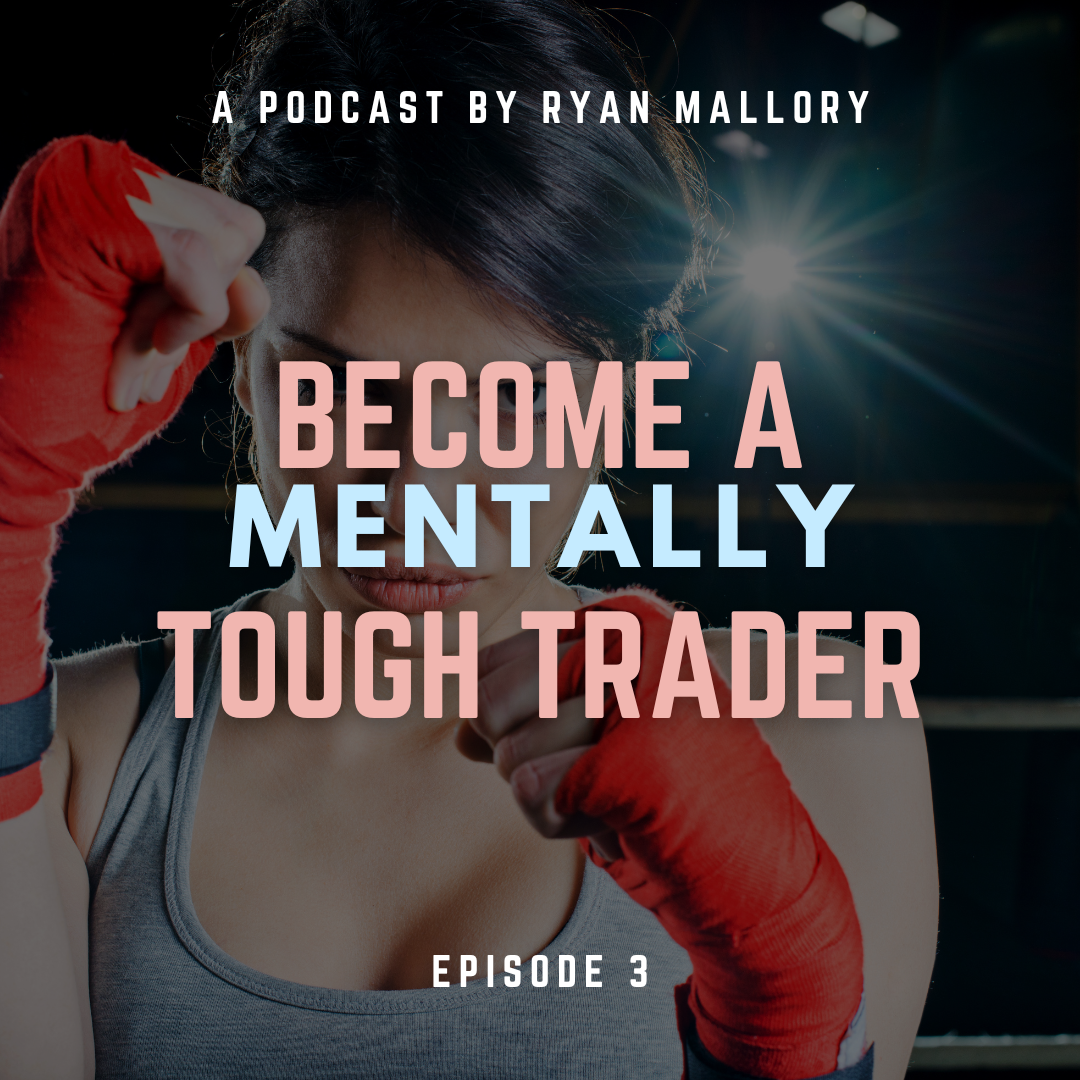
Episode Overview
In this podcast I cover some easy-to-implement trading strategies that will instantly put you on the path to more profits. There are 5 tips in total and all of them can be implemented today.
Available on: Apple Podcasts | Spotify | Amazon | YouTube
Episode Highlights & Timestamps
- [0:00] Why Trading Mentally Breaks So Many People
Ryan explains why the stock market uniquely attacks traders emotionally and why mental toughness is essential for long-term survival and success. - [3:33] Anger Has No Place in Trading
Breaking equipment or losing your temper does nothing to fix bad trades and often causes traders to miss their best opportunities. - [7:46] Dollar Watching Turns Trading Into Gambling
Fixating on profit and loss numbers personalizes trades and leads to emotional decisions instead of disciplined execution. - [10:40] Stop Letting Performance Dictate Your Trades
Daily, weekly, or monthly results should never determine how aggressively you trade or whether you take the next setup. - [14:53] Walking Away Can Save Your Trading Account
Stepping away from the screens helps clear emotions, restore discipline, and prevent costly mistakes driven by frustration.
Key Takeaways from This Episode:
- Emotional Control Is a Trading Skill: Success in trading requires managing emotions just as much as managing charts and risk.
- Anger Leads to Costly Mistakes: Emotional outbursts rarely solve problems and often create new ones inside and outside trading.
- Process Over Profits: Focusing on execution, charts, and risk matters far more than watching profit and loss fluctuate.
- Consistency Reduces Stress: Using the same position size across trades helps remove emotional attachment to individual outcomes.
- Stepping Away Improves Decisions: Taking breaks allows traders to reset mentally and return with clarity and discipline.
Resources & Links Mentioned:
- Swing Trading the Stock Market – Daily market analysis, trade setups, and insights by Ryan Mallory.
- Join the SharePlanner Trading Block – Get real-time trade alerts and community support.

Take the Next Step:
✅ Stay Connected: Subscribe to Ryan’s newsletter to get free access to Ryan’s Swing Trading Resource Library, along with receiving actionable swing trading strategies and risk management tips delivered straight to your inbox.
📈 Level Up Your Trading: Ready for structured training? Enroll in Ryan’s Swing Trading Mastery Course, The Self-Made Trader, and get the complete trading course, from the foundational elements of trading to advanced setups and profitable strategies.
📲 Join the Trading Community: Sign up for SharePlanner’s Trading Block to become part of Ryan’s swing-trading community, which includes all of Ryan’s real-time swing trades and live market analysis.
Full Episode Transcript
Click here to read the full transcript
0:00
All right, this is Ryan Mallory coming at you with podcast number 3. And today I’m going to be talking about 5 trading tips for becoming a more mentally tough trader, OK? So, We all know trading stocks, it’s hard, and there are times where you just want to pull out your hair.
0:20
I know that feeling, which explains some of the hair loss issues I’ve probably already had throughout the years, but because it comes from that notion that nothing can go right, and it seems like Mr. Market has singled you out to humiliate and destroy you. I’ve been there.
0:36
I know what that feeling is like, and I’ve traded now for. 25 years, which accounts for a majority of my life, and there have been so many times where I have been frustrated by trading and even anguished. All the while, the art of successful trading or the psychology of trading per se dictates that only the most mentally sound individuals can handle trading in the stock market, in particular the rigors of day to day trading.
1:08
Now I have learned over the years to control my emotions and that I want to. Do with this podcast here is to show you some easy to implement lessons and tactics that you can use in your trading, as well as provide you with With some, um.
1:26
Quick and easy tips that will help you better control these emotions. Now, at times, the stock market’s going to leave you feeling like. You’re losing trades are just too much to handle. You’re closing out profitable trades are always being done in fear or, you know, worrying about what the next day may hold.
1:48
You know, and, and, and also there’s gonna be times where the stock market’s gonna make you feel like. Um, you’re trading because you are scared of your, of missing out on a bigger move. Or, you know, you combine all those that I’ve just said and you find yourself starting to, you know, break equipment or furniture and, and you, you’re Being overcome with these fits of anger and rage.
2:13
Now the stock market will attack you mentally like no other profession can. I mean, there are very few professions that can really drive you crazy like the stock market. But you see, it doesn’t have to be that way. Now, throughout my trading career, there have always been days where even after the market closes, its influence still lingers strong.
2:32
But I have learned how to keep the stress to a minimum now because if you don’t. There’s no sum of money or profits that you can make from a trade that is worth what you put yourself through if you cannot separate yourself from the day to day trials and adversities that the stock market presents.
2:50
So in order to keep the stress of trading to a minimum, I’m going to go over here with you today a list of 5 things that I’ve compiled a list of trading tips that allows me personally to be more mentally and psychologically stronger in my trading endeavors.
3:08
So what can we do as traders to be more sound in our approach to trading so that we are not sabotaging our pursuit of profitability? Well, here are the, the, like I said, the 5 tips that I’m confident will make you better equipped for handling the pressures of trading. And some of these are pretty simple, while others, you know, they’re going to take some practice and some repetition, but in the end, I am confident that you will be a better trader because of them.
3:33
So here’s tip number one. Don’t break your equipment. I know that sounds crazy, but when you do that, it just takes you down a path that you don’t want to be on. So let’s just get this one straight out of the way. Breaking your equipment won’t make a single trade turn out better for you.
3:50
Getting mad and throwing your mouse or breaking your keyboard, and hey, look, I’m guilty of both, OK? And I’ve done it on multiple occasions in the past, and like I said, you know, that’s. Something that I’ve had to learn to overcome and get better at, and, and thank God that that’s not a part of my trading routine anymore.
4:08
But break all that you want, break your desk, break your screen, break your laptop, break your mouse, break your keyboard, it’s not going to improve your circumstances for you one bit, and it’s likely going to leave you in a very difficult situation when it comes to trading.
4:23
So, Even if you smash your keyboard. Over your trading desk and it doesn’t break, good luck in finding all the keys that are now scattered across the room. And guess what? You still have trades that you’re having to deal with. So, you know, either you run to Best Buy and you get the new keyboard, and hey, if the market conditions are that bad for you that you’re breaking equipment, do you really want to be driving over to Best Buy or trying to figure out how to, you know, get a new keyboard or a new mouse or whatever?
4:57
No. And who wants to take time out of their trading day and to miss better trades that could actually rectify the situation because you had to take time to go to a store and get your 4th keyboard in the last 3 months. Look, I have found that some of the times where I am the most anguished in my trading and the times where I just.
5:17
Um, and the most upset are usually the times too where there’s some great opportunities that if I just push through those times and, and like I said, this was an issue for me when I started off trading a long time ago, but, but now I’ve, I’ve learned from those experiences and what I’m trying to convey here to you guys now is that.
5:37
Is that some of the times the, the worst trading days offer some of the best opportunities to uh turn things around. And, and when the volatility is high, there’s a lot of opportunities to really trade it trade, trade your way out of a hole, but you have to stick through it.
5:53
You can’t go, you know, losing your temper and having emotional fits. And, and if you find that no matter how hard you are trying, you are still taking it out on your keyboard, your mouse, then just consider going away. I, I actually did this, going away from wireless devices because those are the easiest things to break, and buy the ones that are just hardwired into your computer instead, and then at least you’ll reconsider whether it is a good idea just to rip equipment out that is plugged into your computer, because when you start doing that, then, you know, you might be pulling out components of your computer as well, and that’s, you know, that’s a no go.
6:29
So anger and trading is a bad combination, and it doesn’t just apply to computer equipment. It can be the walls in your house that you find it convenient to put a hole in, you know, don’t be like that guy from the Office, Andy, who every time he, you know, got upset, he decided to punch a hole in the wall and, you know, he busted his hand up, wore a cast, whatever, because in the grander scheme of things, if you cannot control your anger when it comes to trading, it will trickle into other parts of your life where you will find yourself to be.
6:56
Let me back that up. If, if you can control how, how you handle yourself in the stock market, that’s going to trickle itself into other parts of your life where you’ll find yourself to be a much cooler, calmer, and collective person, particularly in very high stressful situations.
7:13
Trading can do that if you allow it to, to, to make you a better person, you will actually find that your anger is much easier to be controlled in other situations throughout life because you’ve conquered it in the financial markets. So get it together. Don’t let a string of bad trades or just even one trade cause you to do something you’ll regret instantly afterwards, because I have rarely ever found somebody who wants to high five someone after, after they go break a keyboard or, or slam their hand down on the desk and, you know, hurt themselves.
7:46
All right, so that’s, that’s my first tip. My second tip, don’t dollar watch your account. This has to be one of the worst habits among traders, and not only is it a bad habit, but it’s incredibly lazy. When you were watching the dollar value of your trades and how profitable they are, or unprofitable for that matter, you weren’t trading, you were just playing slots at a casino.
8:10
Watching the dollar value of your trade is not trading. It is not savvy, and it will cause your emotions to get the better of you, which will lead you back to breaking trading tip number one. And we all know we don’t want to break trading tip number one because that’s the anger one.
8:26
Now. Regardless of how good or how bad you are, we all personalize our money, OK? That’s just a natural human tendency. It is. Much easier to keep the emotions out of the trade though, if you eliminate the need to look at the dollar value associated with the profit loss of a trade.
8:43
That’s because when you look at a stock and you see that it’s down $100 you’re going to say to yourself, hey, I could have used that money to pay the water bill, or you lose $400 on a trade and be like, that could have bought me a new cell phone that I broke the other day because of anger.
9:01
Or that grand that I just lost on trade would have paid for this month’s mortgage. And actually down here in Florida, you can get mortgages, you know, for a nice home under $1000. I know it for y’all listening to this in like New York, California, and some of those bigger cities, yeah, you’re not finding that, or even down in South Beach, mortgages are pretty rough down there too.
9:25
So when you start thinking like that, and you start paying attention to the dollars, it is very easy to start personalizing the trade, and that’s where you, you get to the point where you are no longer focusing on the trade itself, but the effects of the trade, and that will lead you to make, excuse me, that will lead you to be Where you’re making an emotional decision.
9:47
So use the privacy settings. Most of the brokerages have them now, and they’ll provide you with the ability to start out the dollar value. It’s basically they’re like privacy settings, um, but they will allow you to start out the dollar value of your profits and losses that you find yourself staring at and instead go back to just looking at the chart and your pre-established stock losses.
10:06
Um, but yeah, I mean, I use Think or Swim, they actually um allow you to start out the The dollar values and it’s like a privacy setting. So like if you’re in a room with a lot of people or something, you can use a privacy setting to, to make it to where people can’t walk by your computer and see the dollar values.
10:23
Well, that’s also good for you as an individual trader because you don’t need to be dollar watching because when you get into the trade, you should already know what the dollar values are to begin with, so you shouldn’t feel the need to be watching them now that you’re in the trade. OK, so we got the 1st 1 out of the way.
10:40
We got the 2nd 1 out of the way. Now, let’s get to the 3rd 1 here. Trading tip number 3, don’t track your performance for the day, week, or the month. It probably sounds a little bit weird to you, right? But whether you make another trade or refrain from making another trade, that should not hinge on whether you are up or down for the month or by how much.
11:02
But a lot of people base whether or not they should be trading right now based on how much they’re up. If they’re up a lot, they’re saying, hey, I’m playing with the house’s money. I can afford to take some losses. No, that’s, that’s not what you should be thinking as a trader. Or if you’re down, it’s like, well, I gotta make this money back. I gotta start trading a little bit more aggressive.
11:18
I gotta start getting the money back, and then you start taking what, you know, if, if you start pulling off a string of winners, you start taking the uh The gains too quickly because you’re thinking about how you’re down on the month, and, and that’s not what you should be focused on when it comes to trading. You should be focused on the charts and, and controlling the risk and, and, and finding opportunities that are going to give you a good trading edge to go into.
11:42
So, Just to sum that up, you shouldn’t take on more risk simply because you were playing with the house’s money or feel the need to trade more just to make up for the losses so far in the week. Instead, you should be trading because the market conditions and the trade opportunities at hand are aligning themselves to provide you with a great trading opportunity.
12:04
So how good or how bad you were doing on the day, week, or month should not dictate how or when you should be trading. Pretty simple, OK. Don’t track the performance of the day, week, or month, because you don’t want that dictating what you do going forward and how, how aggressive or how, uh, less aggressive you are in your trading.
12:25
I don’t track it, and I don’t think you should either. All right, trading psychology tip #4. Use the same amount on every trade. Now look, not everyone’s going to agree with me on this. And that’s OK because we all have different approaches to trading, but if you are struggling with the mental side of trading, one thing that you can do is to make it easier for you to Just Treat all these trades the same, OK.
12:57
Trade with the same size. I do this because I don’t want my attention to be diverted solely to one particular trade because I have a higher allocation of my capital dedicated to it. Instead, I put 10% of my capital on each of my trades, never more, never less. It is something I don’t have to think about or consider because I know that when I trade, it is worth 10% of my capital to be allocated to that particular trade.
13:18
I don’t have trades that are like 30% here, 20% there, 50% somewhere else. I don’t do that because then all of a sudden my focus gets diverted to the higher value trades, and I believe that all trades should be treated the same, OK? At least from my strategy standpoint.
13:34
I treat them all the same, they just become trades. I don’t become married to a trade because I have so much money in it. I don’t double down on stocks because I can’t afford to lose. All trades are kept the same, OK? All losses are the same. All profits are, you know, the same, you know, they might have different returns, but my approach to them are all the same.
13:53
This will also keep you from doubling down on a trade or being overly confident on its prospects. Instead, you’ll just see it as another trade, just like I said. Besides, the worst thing that you could do is be overzealous of a trading opportunity, put 50% of your capital towards it, and then find out that the trade dropped 10% in value and just wiped out the other 5 trades at 10% gains that.
14:14
That you had a 10% portfolio application that gave you 10% gains each, OK? A big 50% position on one trade wipes out a whole slew of other good winning trades that that you might have had before then. Now you can do this by uh.
14:32
Simply using, and I have this in my free uh trading resource library. If you go to the top of my website, it’s free resources, click on that. There’s a shares allocation. You, you’ll sign up, you put your, put your email in there, and I’ll send you a shares allocation spreadsheet. That spreadsheet is going to show you how to keep all your trades, you know, the same, the same amount.
14:53
All right, time for the last one, and this is very easy to do, and I do this all the time because I have to, and that is to go for a walk. I would lose my mind if I didn’t. I take a walk around the block and it usually allows me to clear my head and think things through in terms of strategy and what is best interest of my trading and the positions that I currently have.
15:13
If you can leave your cell phone at your home or your office. Just rely on your preset stop losses. That’s what they’re there for, and walk distraction free. Otherwise you might find your walk is just another outdoor excursion of you staring down at your cell phone the whole time, and we don’t want that.
15:28
You’ll be amazed at what comes to mind when you step away from the charts for a few minutes. You’ll also stimulate the brain with some exercise, which we can all agree we probably can afford to do more of. Oh, back to trading tip number one, you know, by taking that walk, you just might save the life of a keyboard or one of your mouses.
15:47
So let’s go ahead and just wrap this up. There’s a lot to speak of when it comes to trading psychology, OK, and how you can improve your bottom line performance. But what I wanted to do with this podcast here is not spend so much time on the theoretical aspects of it, but to focus on the application side, and that will allow you to instantly become a better trader.
16:05
I’ve given you 5 tips, OK, to become a better trader. They’re, they’re psychological, they’re mental, and they’re very easy to implement, but you got to do it, OK? By applying these trading tips to your daily routine, you’re gonna find that you are making much better decisions, and decisions is what leads to profitability.
16:22
When you’re making good decisions, when you’re trading your plan and everything else. And, and, and making good decisions means that you’re following your trading plan too. You are going to be a sound judgment when it comes to determining what trades are in your best interest, or whether or not you should hold on to that trade one more day.
16:40
Simply put, trading is filled with anxiety and emotion. I feel it, you feel it, everybody feels it. And the more of that anxiety and emotion and anger that you can eliminate from your thought process, the better off you’re going to be. So focusing in on the trigger points that cause you to fly off the handle and the tactics that you can employ to counter them, thereby keeping regret from being a central component of your trading life will no doubt make you a better trader.
17:05
All right, and that’s what that’s gonna be it for today. I hope that you guys. Feel like you were able to learn something from it. If you have any questions, always feel free to shoot me an email. I encourage you. If you’re struggling out as a trader or just want to be a part of a trading community to sign up for a free 7 day trial to the SharePlanner trading block, you’re going to find me in there everyday trading with a whole community of traders.
17:30
We’re in there, we’re helping each other get through the day. It’s great people, nice people. There’s no egos. We’re just traders trying to get through the grind of a trading session each and every day. I encourage you to sign up, check it out. If you don’t like it, you can always unsubscribe within the 1st 7 days and not be charged a single dime.
17:47
So. Do it. I look forward to uh seeing you in there, and if you have any questions, just email me. All right, y’all. God bless.
Enjoy this episode? Please leave a 5-star review and share your feedback! It helps others find the podcast and enables Ryan to produce more content that benefits the trading community.
Have a question or story to share? Email Ryan and your experience could be featured in an upcoming episode!
Become part of the Trading Block and get my trades, and learn how I manage them for consistent profits. With your subscription you will get my real-time trade setups via Discord and email, as well as become part of an incredibly helpful and knowledgeable community of traders to grow and learn with. If you’re not sure it is for you, don’t worry, because you get a Free 7-Day Trial. So Sign Up Today!

Welcome to Swing Trading the Stock Market Podcast!
I want you to become a better trader, and you know what? You absolutely can!
Commit these three rules to memory and to your trading:
#1: Manage the RISK ALWAYS!
#2: Keep the Losses Small
#3: Do #1 & #2 and the profits will take care of themselves.
That’s right, successful swing-trading is about managing the risk, and with Swing Trading the Stock Market podcast, I encourage you to email me (ryan@shareplanner.com) your questions, and there’s a good chance I’ll make a future podcast out of your stock market related question.
How does war impact the stock market and what are the potential risks and hazards that impact traders attempting to remain profitable in their swing trading? In this podcast episode, Ryan Mallory covers everything managing the volatility that comes with the headline risk, dealing with heightened levels of emotions, securing open profits, and market exposure to uncertainty in the stock market.
Be sure to check out my Swing-Trading offering through SharePlanner that goes hand-in-hand with my podcast, offering all of the research, charts and technical analysis on the stock market and individual stocks, not to mention my personal watch-lists, reviews and regular updates on the most popular stocks, including the all-important big tech stocks. Check it out now at: https://www.shareplanner.com/premium-plans
📈 START SWING-TRADING WITH ME! 📈
Click here to subscribe: https://shareplanner.com/tradingblock
— — — — — — — — —
💻 STOCK MARKET TRAINING COURSES 💻
Click here for all of my training courses: https://www.shareplanner.com/trading-academy
– The A-Z of the Self-Made Trader –https://www.shareplanner.com/the-a-z-of-the-self-made-trader
– The Winning Watch-List — https://www.shareplanner.com/winning-watchlist
– Patterns to Profits — https://www.shareplanner.com/patterns-to-profits
– Get 1-on-1 Coaching — https://www.shareplanner.com/coaching
— — — — — — — — —
❤️ SUBSCRIBE TO MY YOUTUBE CHANNEL 📺
Click here to subscribe: https://www.youtube.com/shareplanner?sub_confirmation=1
🎧 LISTEN TO MY PODCAST 🎵
Click here to listen to my podcast: https://open.spotify.com/show/5Nn7MhTB9HJSyQ0C6bMKXI
— — — — — — — — —
💰 FREE RESOURCES 💰
— — — — — — — — —
🛠 TOOLS OF THE TRADE 🛠
Software I use (TC2000): https://bit.ly/2HBdnBm
— — — — — — — — —
📱 FOLLOW SHAREPLANNER ON SOCIAL MEDIA 📱
*Disclaimer: Ryan Mallory is not a financial adviser and this podcast is for entertainment purposes only. Consult your financial adviser before making any decisions.
You Might Like
Stop Trying to Hit Home Runs: Start Trading Within Your Means
How to Trade Breakouts Without Getting Trapped

Managing Headline Risk: How to Survive the News Cycle Without Losing Your Mind