
There are days in the market that test your resolve, and today is one of them. If you have been watching silver, you know exactly what I mean. We are seeing an aggressive move lower that is triggering panic selling. Fortunes are being won and lost on this kind of volatility.
It is ugly out there. And when a commodity takes a nosedive like this, it is natural to feel shock and the urge to buy the dip. Your brain sees yesterday’s price and screams bargain.
But pause. Take a breath. This is a falling knife. If you try to catch it before it hits the floor, you are going to get cut.
Understanding the Breakdown in SLV
For traders using the iShares Silver Trust (SLV) to get exposure to silver, today’s action is a masterclass in volatility. SLV is an ETF designed to reflect silver’s price, making it a common vehicle for traders who want metal exposure without holding physical silver.
But SLV is subject to the same laws of gravity as the underlying asset. When spot silver breaks down hard, the ETF follows.
Look at the chart below. This was not a slow bleed. This was a violent break of structure.
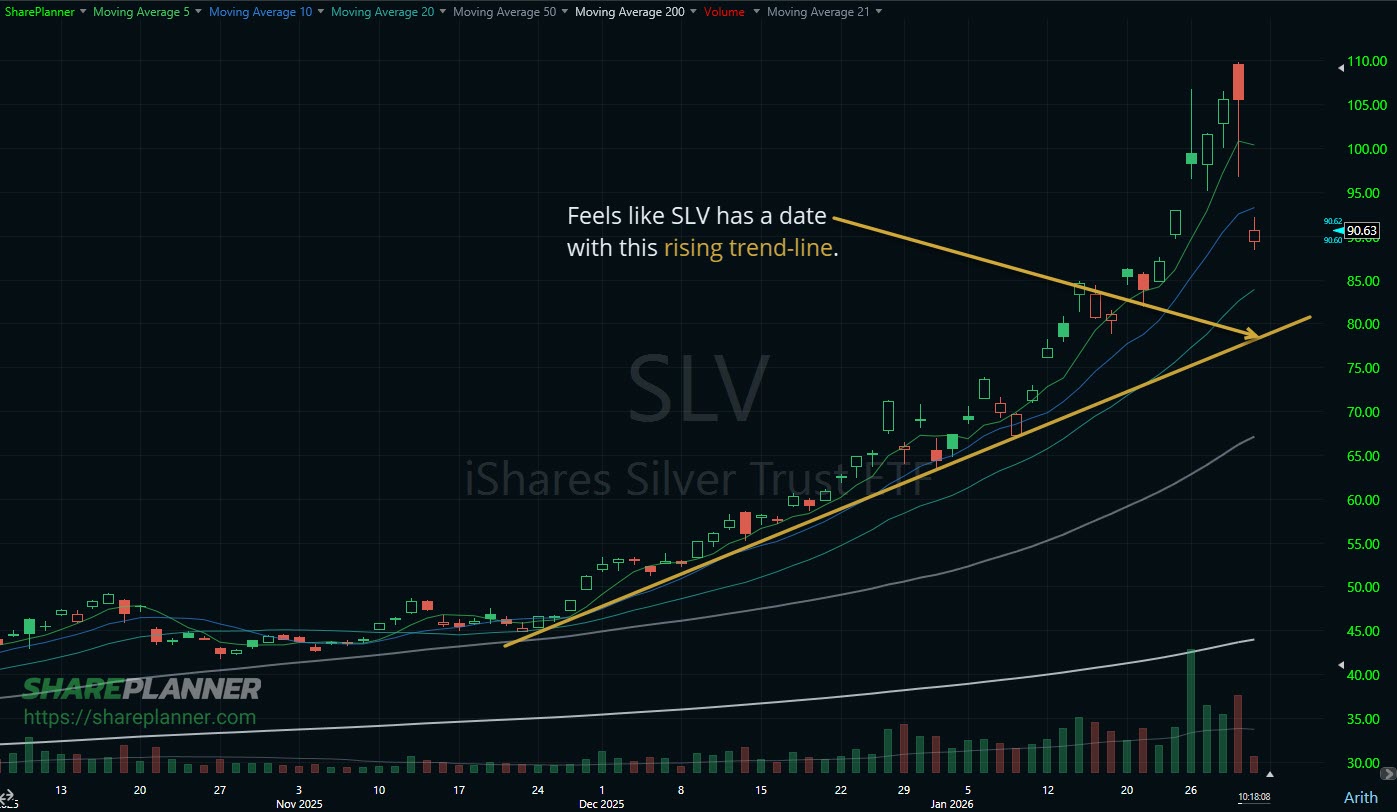
The damage is obvious. Short-term moving averages have been violated and price sliced through levels many traders expected to hold. This is downside momentum in its purest form.

The Danger of Trying to Call a Bottom
The biggest mistake traders make on days like this is trying to be a hero. They want the bragging rights of buying the exact bottom tick.
Trading is not about ego. It is about making money and managing risk.
Trying to buy SLV while it is plunging is the financial equivalent of stepping in front of a freight train and hoping it stops. Markets have inertia. When selling pressure is this intense, it takes time for the energy to dissipate.
Price discovery is happening in real time. The market is trying to find where silver is truly valued, and until selling volume dries up, there is no reason to put capital at risk.
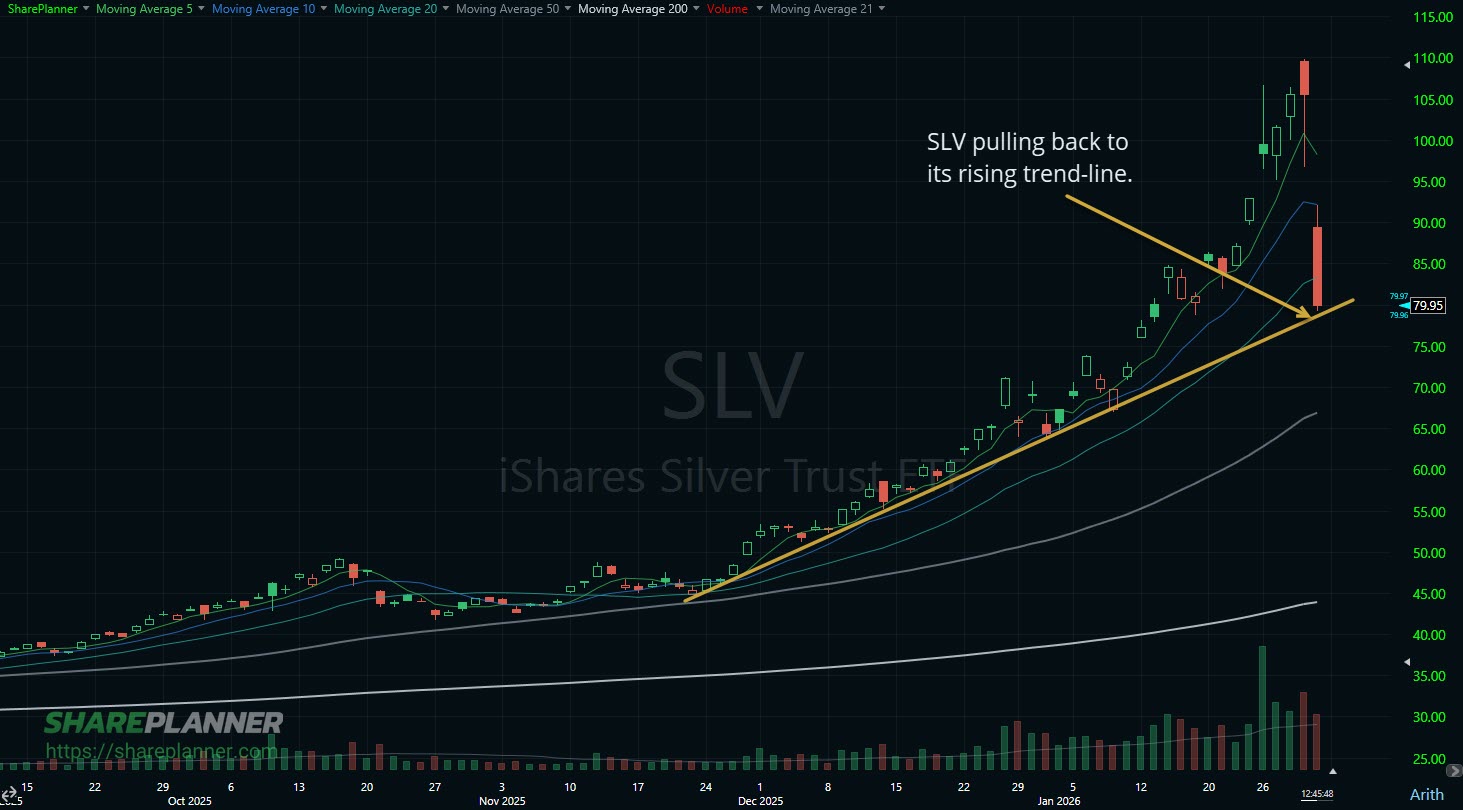
As the chart shows, price did not just fall. It ignored support zones on the way down. That is a clear signal sellers are in full control. Buying here is gambling on a bounce rather than trading a setup.
How Much Further Could Silver Fall?
So how low can it go?
From a technical standpoint, the focus becomes structural support. We are looking for levels where buyers stepped in aggressively in the past.
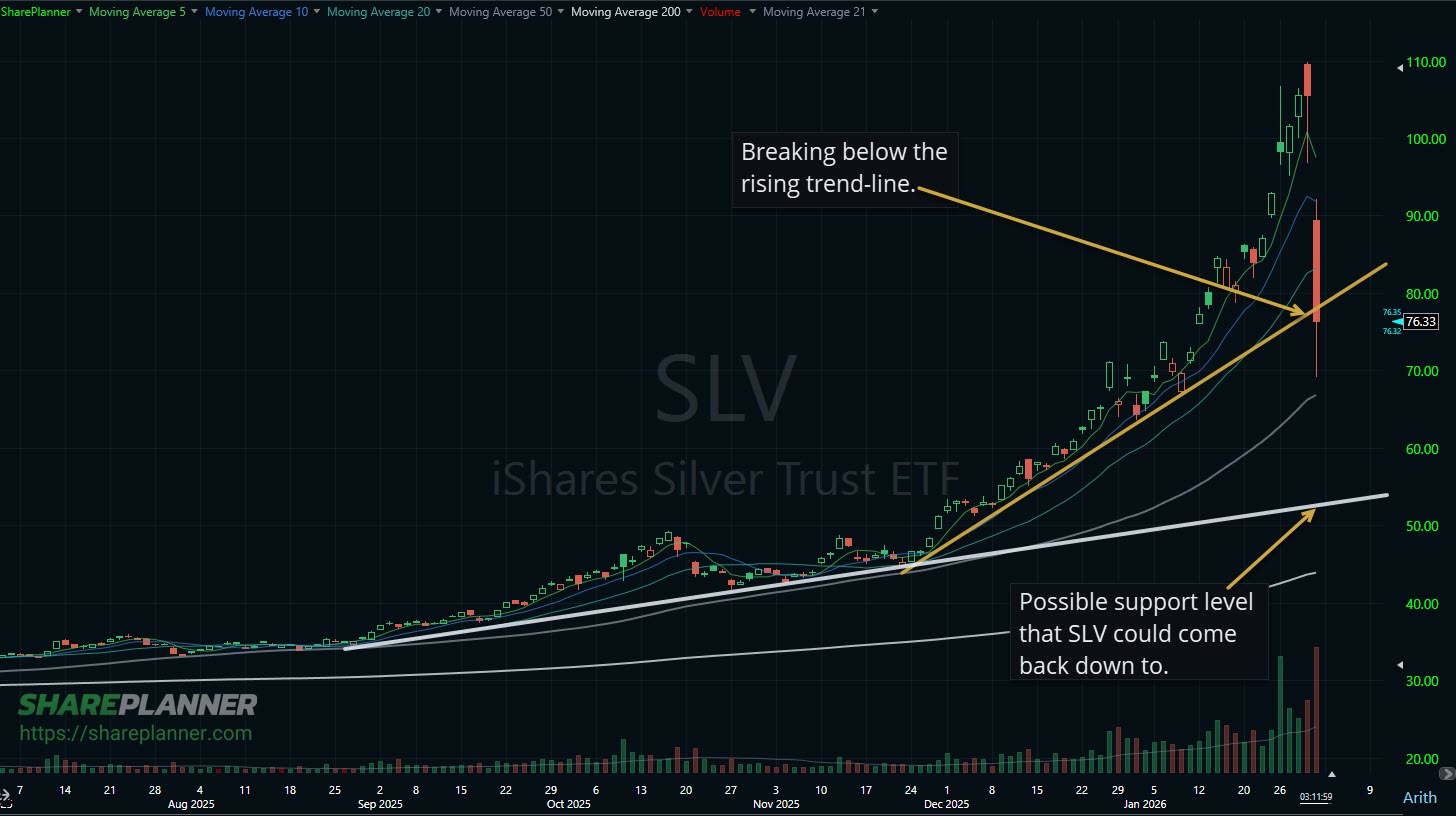
This chart should highlight the risk profile. There may be plenty of room lower before price reaches a structural floor that truly matters. Buying too early exposes you to unnecessary drawdown.
The key is patience. We need to see SLV stop going down before we can consider it going up. That means a support test, a hold, and then a bounce. That confirmation creates a defined level for risk. Without it, you are guessing.
A Strategy for Volatile Crashes
So what should you do when a stock or commodity implodes like this?
Here is my checklist for handling a crash:
- Sit on your hands: The best trade right now is often no trade. Cash is a position. It protects your capital and keeps your head clear.
- Wait for the dust to settle: Let volatility cool down. You want to see the range tighten as buyers and sellers move toward equilibrium.
- Look for the retest: Do not buy the first bounce. Wait for price to retest the lows. If it holds, a bottom may be forming.
- Manage risk always: If you eventually take a position, place stops based on technical levels, not arbitrary dollar amounts.
Don’t Let FOMO Dictate Your Trades
Fast moves trigger fear of missing out. You worry that if you do not buy now, you will miss a V-shaped recovery.
But V-shaped recoveries are rare. More often, crashes lead to sideways chop or a dead cat bounce followed by lower lows.
If SLV remains this volatile, risk becomes impossible to manage. Stops must be so wide that reward-to-risk breaks down. And if the math does not make sense, the trade does not make sense.
Conclusion
Today’s silver crash is a reminder that the market can remain irrational longer than you can remain solvent. Whether this is a temporary shock or the start of a deeper correction remains to be seen.
Your job is not to predict the future. Your job is to react to what the charts are telling you. Right now, the charts are screaming caution.
Let the falling knife hit the floor. Let it bounce and settle. When volatility calms and support proves itself, then you can evaluate a trade with defined risk.
Doing nothing is hard when markets are moving like this. But sometimes doing nothing is the most profitable decision you can make.
Become part of the Trading Block and get my trades, and learn how I manage them for consistent profits. With your subscription you will get my real-time trade setups via Discord and email, as well as become part of an incredibly helpful and knowledgeable community of traders to grow and learn with. If you’re not sure it is for you, don’t worry, because you get a Free 7-Day Trial. So Sign Up Today!
Frequently Asked Questions About the Silver Crash
What does “falling knife” mean in trading?
A falling knife refers to a sharp, accelerating selloff where buying too early can lead to immediate losses. Traders usually wait for price to stabilize and confirm support before entering.
What is SLV and how does it track silver?
SLV is an ETF designed to reflect the price of silver. When spot silver drops sharply, SLV typically follows with similar downside movement.
Should you buy silver after a big crash?
Not without confirmation. A crash can continue longer than traders expect. It is better to wait for a support hold, a stabilization period, and a confirmed bounce before taking risk.
What signs suggest silver is forming a bottom?
Key signs include selling volume drying up, price holding a structural support level, volatility tightening, and a successful retest of the lows.
Why is buying the first bounce risky?
First bounces often fail. Markets frequently retest lows after initial relief rallies. Waiting for a retest improves confirmation and risk control.
How do swing traders manage crashes safely?
They reduce position sizing, avoid emotional entries, wait for volatility to compress, and use technical levels to define risk and stop placement.


Welcome to Swing Trading the Stock Market Podcast!
I want you to become a better trader, and you know what? You absolutely can!
Commit these three rules to memory and to your trading:
#1: Manage the RISK ALWAYS!
#2: Keep the Losses Small
#3: Do #1 & #2 and the profits will take care of themselves.
That’s right, successful swing-trading is about managing the risk, and with Swing Trading the Stock Market podcast, I encourage you to email me (ryan@shareplanner.com) your questions, and there’s a good chance I’ll make a future podcast out of your stock market related question.
Watching the dollars rise and fall in your trading account can turn a well-planned swing trade into an emotional, deeply personal decision. In this episode, I explain why focusing on price action, percentage returns, and R-multiples can help you avoid cutting winners early, holding losers too long, and abandoning your trading plan.
Be sure to check out my Swing-Trading offering through SharePlanner that goes hand-in-hand with my podcast, offering all of the research, charts and technical analysis on the stock market and individual stocks, not to mention my personal watch-lists, reviews and regular updates on the most popular stocks, including the all-important big tech stocks. Check it out now at: https://www.shareplanner.com/premium-plans
📈 START SWING-TRADING WITH ME! 📈
Click here to subscribe: https://shareplanner.com/tradingblock
— — — — — — — — —
💻 STOCK MARKET TRAINING COURSES 💻
Click here for all of my training courses: https://www.shareplanner.com/trading-academy
– The A-Z of the Self-Made Trader –https://www.shareplanner.com/the-a-z-of-the-self-made-trader
– The Winning Watch-List — https://www.shareplanner.com/winning-watchlist
– Patterns to Profits — https://www.shareplanner.com/patterns-to-profits
– Get 1-on-1 Coaching — https://www.shareplanner.com/coaching
— — — — — — — — —
❤️ SUBSCRIBE TO MY YOUTUBE CHANNEL 📺
Click here to subscribe: https://www.youtube.com/shareplanner?sub_confirmation=1
🎧 LISTEN TO MY PODCAST 🎵
Click here to listen to my podcast: https://open.spotify.com/show/5Nn7MhTB9HJSyQ0C6bMKXI
— — — — — — — — —
💰 FREE RESOURCES 💰
— — — — — — — — —
🛠 TOOLS OF THE TRADE 🛠
Software I use (TC2000): https://bit.ly/2HBdnBm
— — — — — — — — —
📱 FOLLOW SHAREPLANNER ON SOCIAL MEDIA 📱
*Disclaimer: Ryan Mallory is not a financial adviser and this podcast is for entertainment purposes only. Consult your financial adviser before making any decisions.
You Might Like

South Korea: The Hidden Driver of US Tech Volatility

Stop Trying to Hit Home Runs: Start Trading Within Your Means
How to Trade Breakouts Without Getting Trapped